The Geoengineering Put: Ecological Debt, Termination Risk, and Asset Prices
Solar geoengineering acts as a put option on climate damages, raising brown-firm valuations today but creating termination risk that could render these firms toxic assets if deployment stops.
Featured in No. 140 on 20 Nov 2026 · 3 days after release
- Released
- 17 Nov 2026
- First featured
- No. 140 · 20 Nov 2026
- Published in
- Not yet, as far as Semantic Scholar knows
- Fanfare
- 3 of 5
- Identifier
- arXiv:2611.21568
- Authors
- Samuel Hartzmark and Kelly Shue
Abstract
From arXiv (CC0).
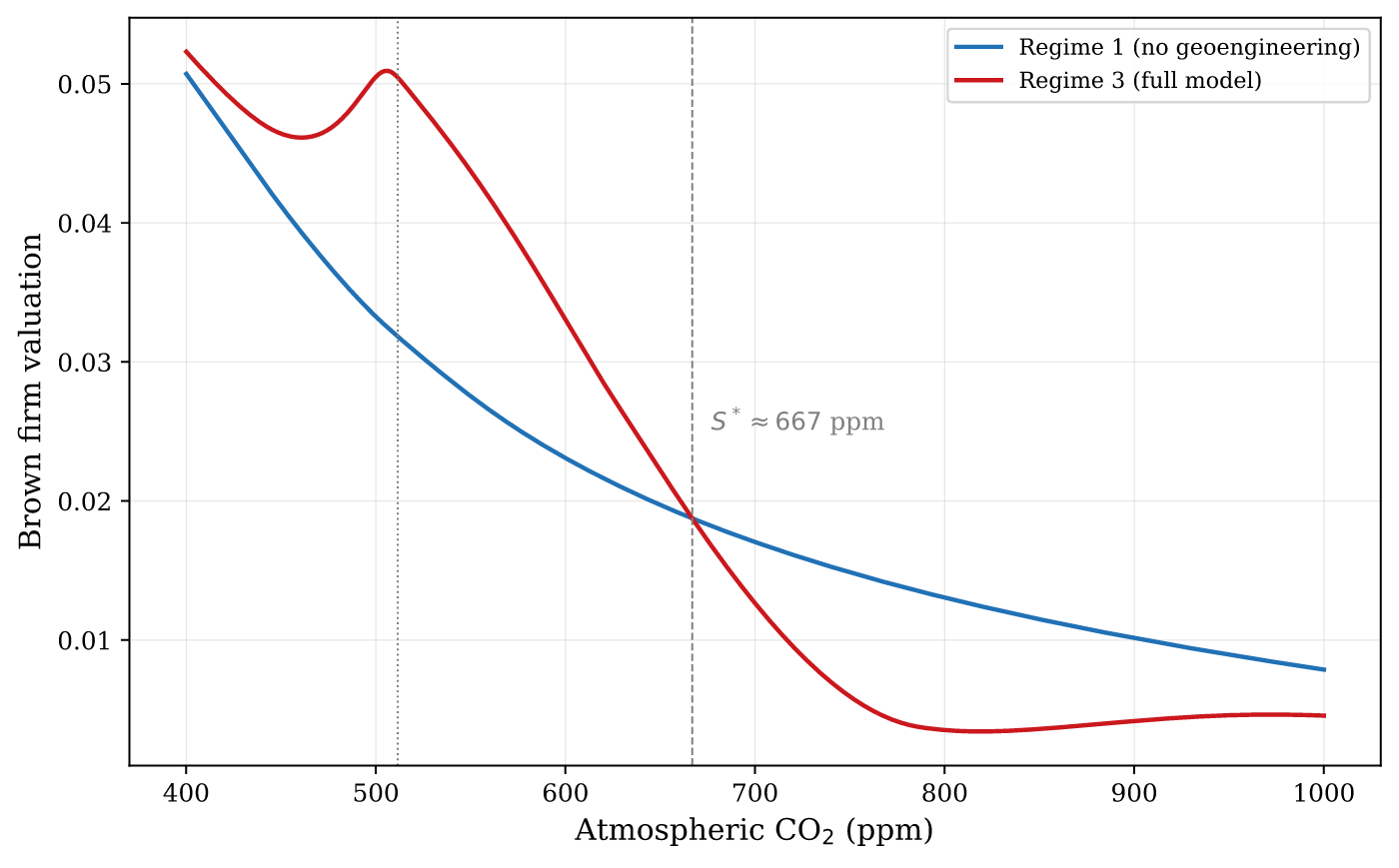
Solar geoengineering offers an inexpensive and fast-acting way to lower global temperatures without removing carbon from the atmosphere. As warming intensifies, climate-vulnerable countries face growing incentives to deploy geoengineering unilaterally. The economic and financial consequences of this prospect remain largely overlooked. We develop a general equilibrium macro-finance framework in which geoengineering acts as a put option on climate damages, funded by the "ecological debt" of masked warming. If deployment stops, temperatures snap back in a catastrophic termination shock. Anticipation of geoengineering raises current brown firm valuations and lowers the optimal carbon tax, helping explain two puzzles in the existing literature: high brown-firm valuations and low carbon taxes. As ecological debt grows, however, termination risk transforms brown firms into toxic assets. Geoengineering also reshapes green innovation: it buys time for a breakthrough, but can weaken innovation incentives by lowering energy and carbon prices. Termination risk partly restores research incentives and directs them toward carbon removal, which can retire ecological debt. Our calibrations show that the geoengineering put can raise welfare across a range of parameter assumptions. Our framework clarifies how this conclusion depends on uncertain parameters and where further research is most needed.
Citations and venue from Semantic Scholar (ODC-BY), refreshed weekly. Summary: Quant Letter (CC BY 4.0).