arXivLLMs & Text
Reading or Remembering? Measuring Temporal Contamination in Language Models
Compares modern language models to chronologically consistent baselines on FOMC statements, finding lookahead premiums in real-time GDP nowcasts are undetectable at macroeconomic sample sizes.
Featured in No. 140 on 20 Nov 2026 · 3 days after release
- Released
- 17 Nov 2026
- First featured
- No. 140 · 20 Nov 2026
- Published in
- Not yet, as far as Semantic Scholar knows
- Fanfare
- 2 of 5
- Identifier
- arXiv:2611.21554
- Authors
- Arunkumar V et al.
Abstract
From arXiv (CC0).
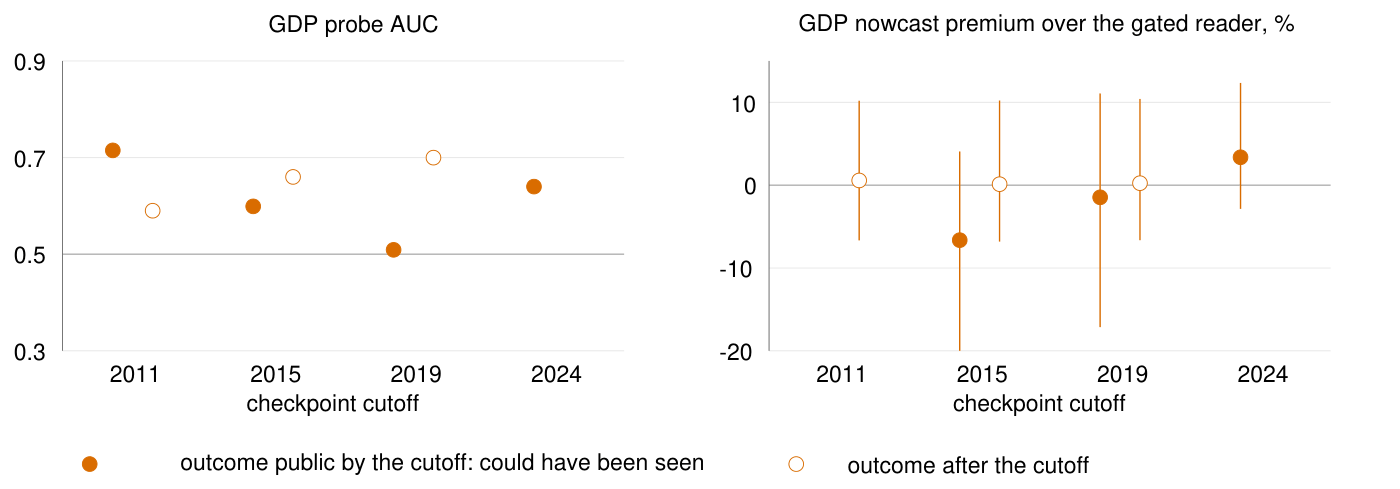
Language models are now used to read central-bank text for economic forecasting, but most were trained on text written after the documents they read. A model reading a 2021 FOMC statement may already know that inflation rose in 2022, so part of its apparent skill can be memory of the outcome, a temporal form of test-set contamination. We measure this memory on FOMC statements and minutes from 2000 to 2026 by comparing modern open models with chronologically consistent models, which are trained only on text from before a fixed date. Asked about past GDP outcomes given only a date, models that cannot know the answer still reach an AUC of up to 0.64 from priors on dates and eras, so chance is the wrong baseline. Against these memory-free models on the same questions, most modern models recall which years had strong growth. Membership-inference scores sort documents by era and document type rather than by whether a model saw them, as exact counts in an open pretraining corpus show. In real-time nowcasts, every lookahead premium we estimate on US GDP is smaller than the forecast comparison can detect at macroeconomic sample sizes, and none on GDP or inflation survives correction for multiple testing. Lookahead audits should therefore measure memory directly against memory-free models on the same items.
Citations and venue from Semantic Scholar (ODC-BY), refreshed weekly. Summary: Quant Letter (CC BY 4.0).