Strategic Repayment and Latent Fragility in Financial Networks: Why Banks Withhold Payable Liquidity
The study shows that banks may rationally withhold feasible payments to insure against future funding needs, creating multiple equilibria and hidden fragility even under stable fundamentals.
Featured in No. 140 on 20 Nov 2026 · 3 days after release
- Released
- 17 Nov 2026
- First featured
- No. 140 · 20 Nov 2026
- Published in
- Not yet, as far as Semantic Scholar knows
- Fanfare
- 3 of 5
- Identifier
- arXiv:2611.21262
- Authors
- Hicham El Kaissi
Abstract
From arXiv (CC0).
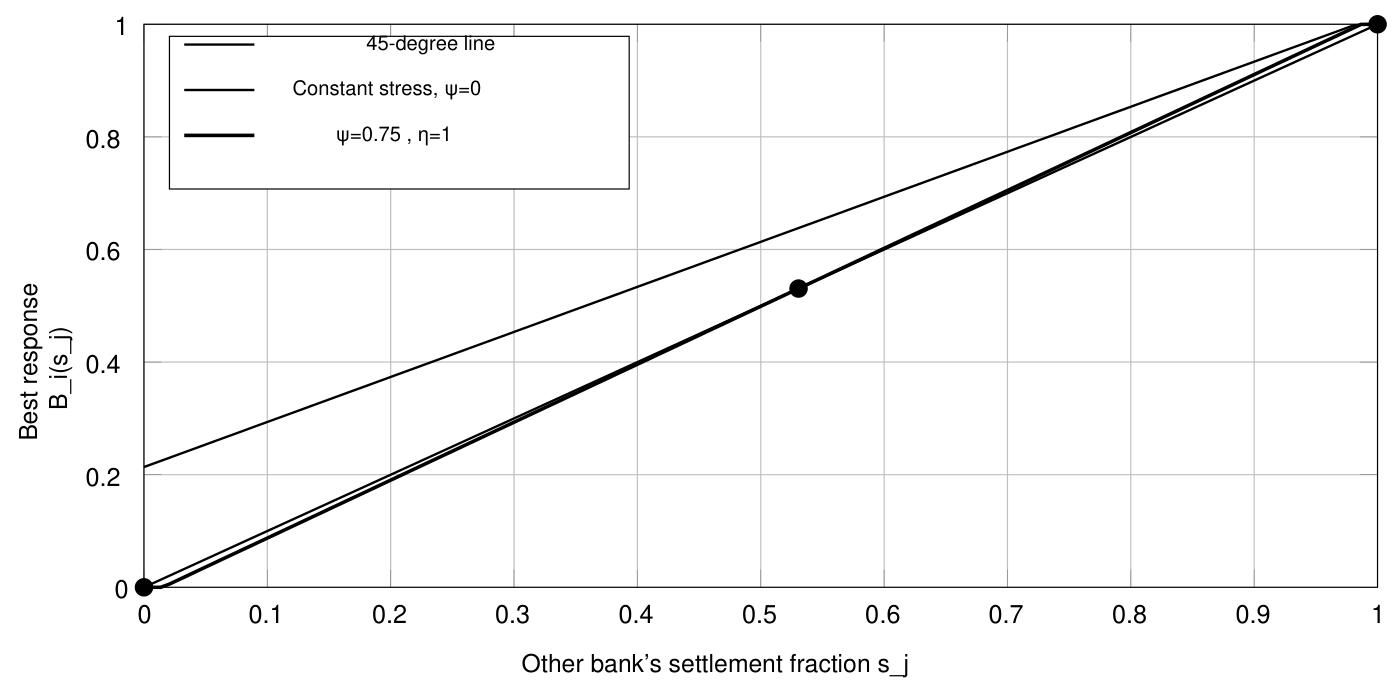
A network in which every bank pays in full can nevertheless admit a self-fulfilling settlement freeze under the same balance-sheet fundamentals. Thus, observing full repayment does not establish the uniqueness or robustness of the payment equilibrium. We derive this result from a precautionary-liquidity choice: banks may delay otherwise feasible payments to insure an interim funding need, trading a positive settlement-discipline cost against the marginal value of retained cash. The optimal reserve is a critical quantile of future liquidity requirements, and the repayment rule nests Eisenberg-Noe maximal feasible clearing exactly. Counterparty underpayment both reduces current cash and raises desired reserves. We characterise network amplification and the conditions for coexistence, including a homogeneous two-bank GPD frontier in which interbank exposure and maximum funding pass-through enter through one dimensionless index. A two-date settlement accounting rule distinguishes payment timing from ultimate default. The main result concerns equilibrium coexistence; the conditional best-response adjustment diagnostic does not assign selection probabilities.
Citations and venue from Semantic Scholar (ODC-BY), refreshed weekly. Summary: Quant Letter (CC BY 4.0).