arXivML & AI Methods
Conditional Asset Pricing Transformer
A two-stage transformer framework decomposes excess returns into conditional mispricing and factor risk compensation while establishing approximation bounds and characterizing prediction error propagation.
Featured in No. 140 on 20 Nov 2026 · 3 days after release
- Released
- 17 Nov 2026
- First featured
- No. 140 · 20 Nov 2026
- Published in
- Not yet, as far as Semantic Scholar knows
- Fanfare
- 3 of 5
- Identifier
- arXiv:2611.19783
- Authors
- Hao Fu et al.
Abstract
From arXiv (CC0).
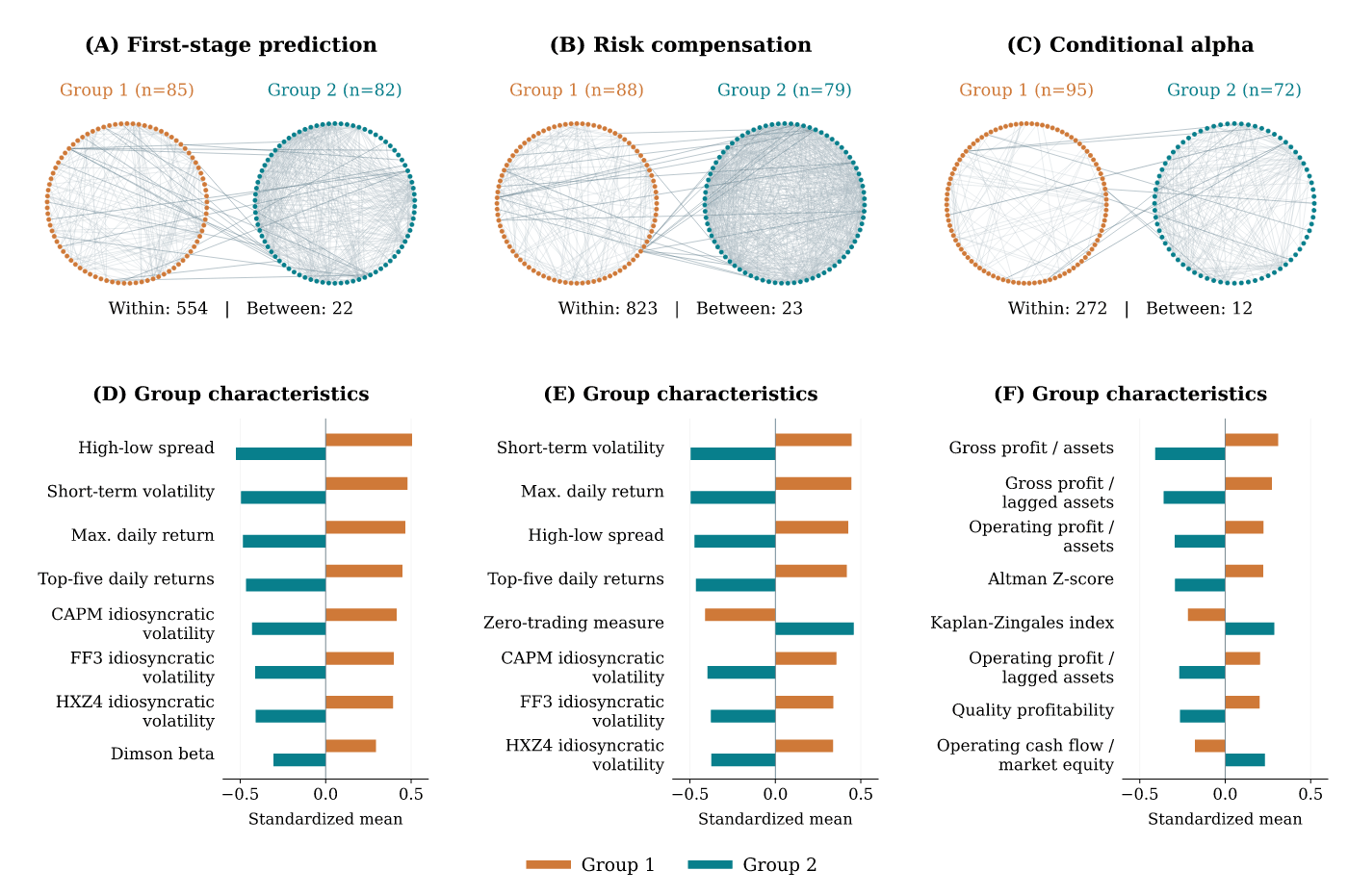
In this paper, we propose a conditional asset pricing transformer (CAP-T) that captures nonlinear interactions among firms through attention to forecast excess returns. In the first stage, a transformer estimates conditional expected returns, and kernel-weighted principal component analysis of its residuals estimates the local factor loading space. Projecting the conditional mean onto this space separates factor risk compensation from conditional mispricing. Then, in the second stage, separate transformers learn these two components, whose predictions are combined to forecast returns. As a result, the proposed framework decomposes returns into conditional mispricing, factor risk compensation, a centered factor component, and an unpredictable innovation. We establish approximation and generalization bounds and characterize how first-stage prediction errors propagate through local factor estimation and component learning, providing statistical guaranties for conditional mispricing, factor loadings, and factor risk premia. Finally, simulations and empirical studies demonstrate the predictive and interpretive benefits of the proposed method.
Citations and venue from Semantic Scholar (ODC-BY), refreshed weekly. Summary: Quant Letter (CC BY 4.0).