arXivLLMs & Text
Point-in-Time Encoders for Earnings Calls
Encoders trained on earnings calls with yearly cutoffs raise rank correlation of return forecasts by about half and improve earnings-surprise prediction.
Featured in No. 139 on 13 Nov 2026 · 2 days after release
- Released
- 11 Nov 2026
- First featured
- No. 139 · 13 Nov 2026
- Published in
- Not yet, as far as Semantic Scholar knows
- Fanfare
- 2 of 5
- Identifier
- arXiv:2611.14325
- Authors
- Alessio Brini
Abstract
From arXiv (CC0).
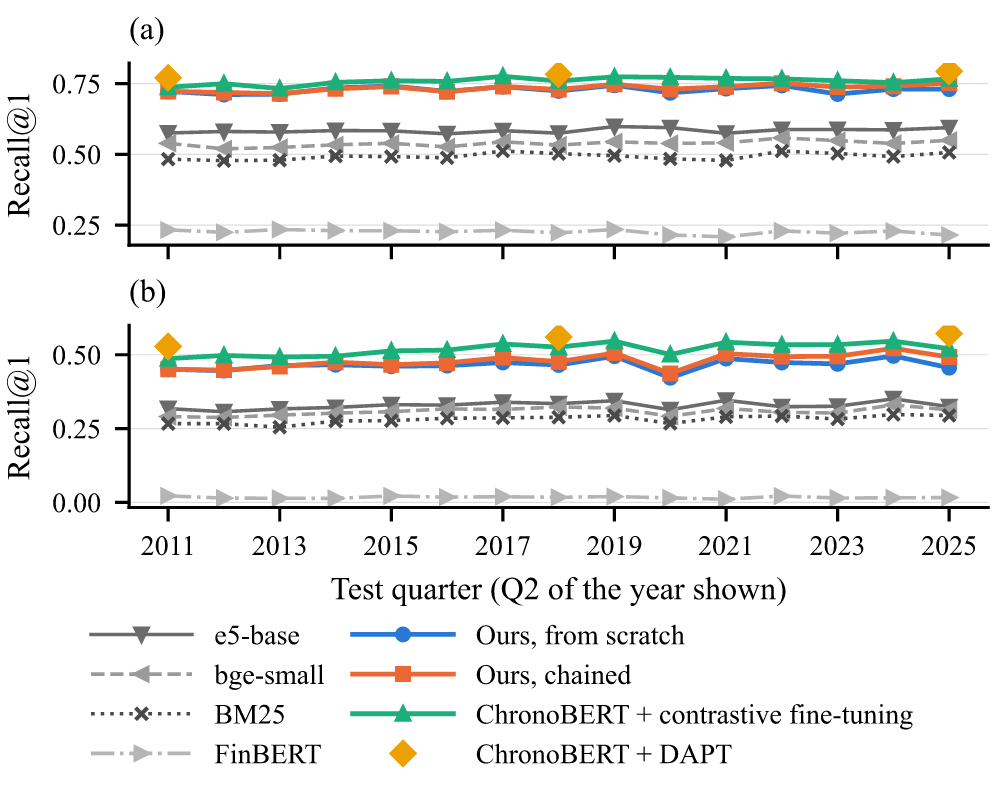
Text encoders turn earnings calls into vectors for search, for language models that answer from retrieved passages, and for forecasting models. A live retriever can use an encoder trained once on all available text, as finance retrievers are, but a backtest needs an encoder that read no text written after the date of each vector. To address this look-ahead bias, from 412,248 calls we train vintages under four pretraining recipes, with yearly cutoffs from 2010 to 2024, and each vintage reads only text dated on or before its cutoff. We then fine-tune each vintage on the question-answer pairs of the calls themselves. The vintages we train on calls alone, with 33.8M parameters, retrieve answers on held-out calls better than the general retrievers we tested in every test quarter. Their vectors also raise by about half the rank correlation between next-day returns and forecasts built from past returns and firm size. When each vintage continues the previous one, a later vintage retrieves better on earlier quarters than the vintage available at the time, and a point-in-time language model that answers from the passages the later vintage retrieves inherits the gain. The 2024 vintage of our families also forecasts earnings surprises better, although the interval of this gain includes zero on calls that no vintage read. It forecasts returns no better, so point-in-time vintages matter most for retrieval and little for forecasts of returns.
Citations and venue from Semantic Scholar (ODC-BY), refreshed weekly. Summary: Quant Letter (CC BY 4.0).