Optimal Radial Weighting for Robust Mutual Fund Selection
Develops a robust procedure using radially weighted alpha estimation to identify skilled mutual funds, controlling false discovery rates even under heavy-tailed returns and cross-fund dependence.
Featured in No. 139 on 13 Nov 2026 · 3 days after release
- Released
- 10 Nov 2026
- First featured
- No. 139 · 13 Nov 2026
- Published in
- Not yet, as far as Semantic Scholar knows
- Fanfare
- 3 of 5
- Identifier
- arXiv:2611.11762
- Authors
- Ping Zhao et al.
Abstract
From arXiv (CC0).
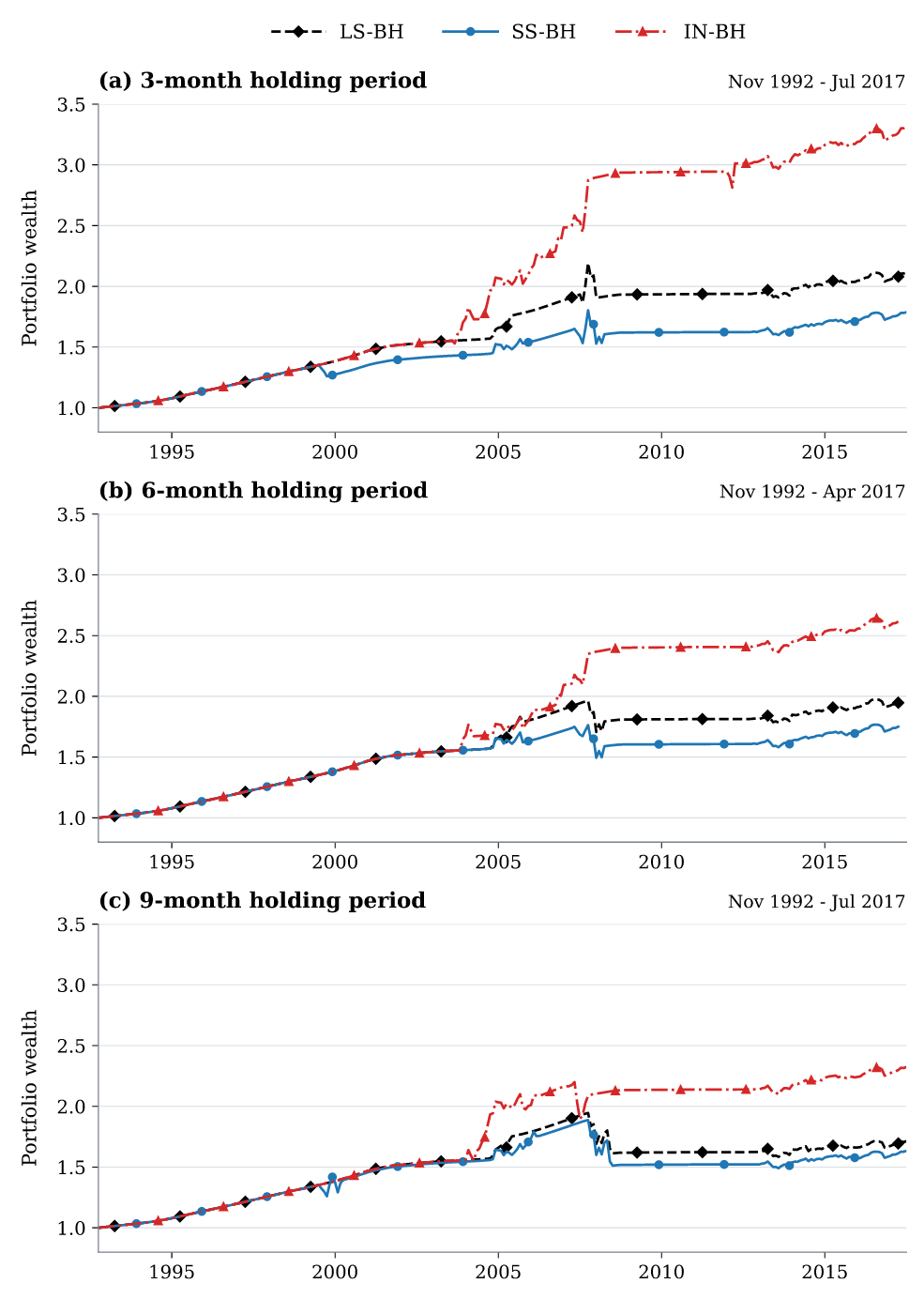
Identifying skilled mutual funds requires methods that distinguish positive alphas from sampling variation when many funds are evaluated simultaneously. Heavy-tailed returns and dependence across funds complicate this task. We propose a robust selection procedure based on radially weighted alpha estimation in linear factor pricing models. The method uses both the directions and lengths of standardized residuals, estimates marginal scales from pairwise residual differences, and accounts for the estimation of factor loadings. Within the proposed class, inverse-norm weighting minimizes the asymptotic variance of the alpha estimators and maximizes the local asymptotic power of individual tests at a common significance level. For radial weights fixed conditional on the factor design, we establish asymptotic false discovery rate control under elliptically symmetric errors and show that the proportion of sufficiently strong positive-alpha funds selected tends to one. The theory accommodates comparable cross-sectional and time-series dimensions and nonvanishing alphas. We also develop a smoothed implementation and assess its finite-sample properties. Simulations show higher true discovery proportions than least-squares and spatial-sign methods under heavy-tailed distributions and improved numerical stability from smoothing. An application to U.S. equity mutual funds examines the subsequent performance of portfolios formed from the selected funds.
Citations and venue from Semantic Scholar (ODC-BY), refreshed weekly. Summary: Quant Letter (CC BY 4.0).