arXivTrading, Microstructure & Execution
Risk-Sensitive Reinforcement Learning for an Options Market Maker: An Empirical Study with Real S&P 500 Options
A reinforcement learning agent trained on historical S&P 500 options data reduces tail losses by 3.1% versus delta hedging, reaching 8.9% in volatile downturns.
Featured in No. 139 on 13 Nov 2026 · 3 days after release
- Released
- 10 Nov 2026
- First featured
- No. 139 · 13 Nov 2026
- Published in
- Not yet, as far as Semantic Scholar knows
- Fanfare
- 3 of 5
- Identifier
- arXiv:2611.10956
- Authors
- Jacky Chen et al.
Abstract
From arXiv (CC0).
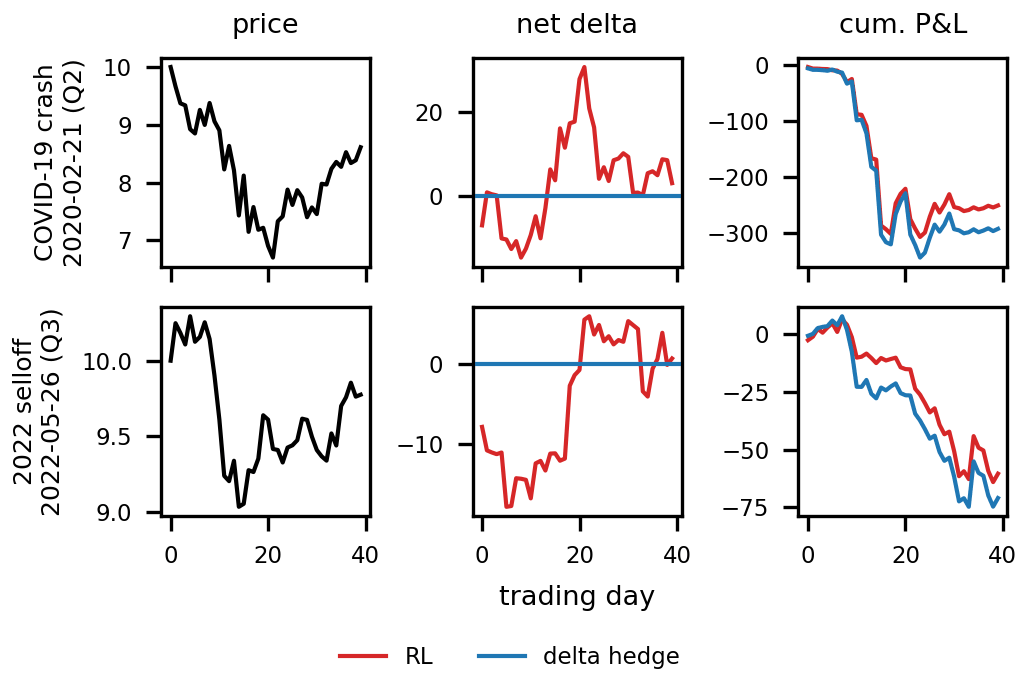
Options market makers absorb client order flow and must hedge the resulting inventory risk under trading frictions. We study whether an option hedging reinforcement learning (RL) agent trained on historical market data outperforms three alternatives in tail-risk protection: (i) traditional delta hedging, (ii) simple hedge-ratio rules, and (iii) the same agent trained in simulated markets. Most RL hedging agents are trained in model-generated markets that do not capture the crashes and volatility regimes present in real data. We introduce an empirical replay environment using S&P 500 option data from 1996 to 2017 and compare against a matched geometric Brownian motion (GBM) environment, a stochastic-volatility (SABR) simulator, and a hybrid that values historical paths with Black-Scholes, all sharing the same portfolio mechanics, stochastic arrivals, costs, and test period. We train a distributional Twin Delayed Deep Deterministic Policy Gradient (TD3) agent and evaluate it out of sample over 2018-2023. The agent trained on empirical data reduces Conditional Value-at-Risk (CVaR) tail loss by 3.1% compared to delta hedging and outperforms every hedge-ratio rule chosen during the training period and every alternative training environment. The reduction reaches 8.9% in volatile and falling markets, but reverses to a cost of 7-10% in rising markets. Empirical training induces a state-dependent short net delta: the policy under-hedges negative-delta books, most strongly after prices have fallen. This tilt disappears with GBM training and is weaker with SABR or hybrid training. These findings suggest that exposure to historical market dynamics can materially change a tail-risk hedging policy, although the evidence rests on a single test path and the edge is regime-conditional.
Citations and venue from Semantic Scholar (ODC-BY), refreshed weekly. Summary: Quant Letter (CC BY 4.0).