arXivCrypto & DeFi
M3FT: Micro-Macro-Micro Reasoning for Multi-Agent Cryptocurrency Perpetual Futures Trading
A micro-macro-micro framework combining numerical states with linguistic market interpretations and cross-asset communication improves coordinated trading decisions in perpetual futures.
Featured in No. 139 on 13 Nov 2026 · 3 days after release
- Released
- 10 Nov 2026
- First featured
- No. 139 · 13 Nov 2026
- Published in
- Not yet, as far as Semantic Scholar knows
- Fanfare
- 2 of 5
- Identifier
- arXiv:2611.10586
- Authors
- Jiashun Wang et al.
Abstract
From arXiv (CC0).
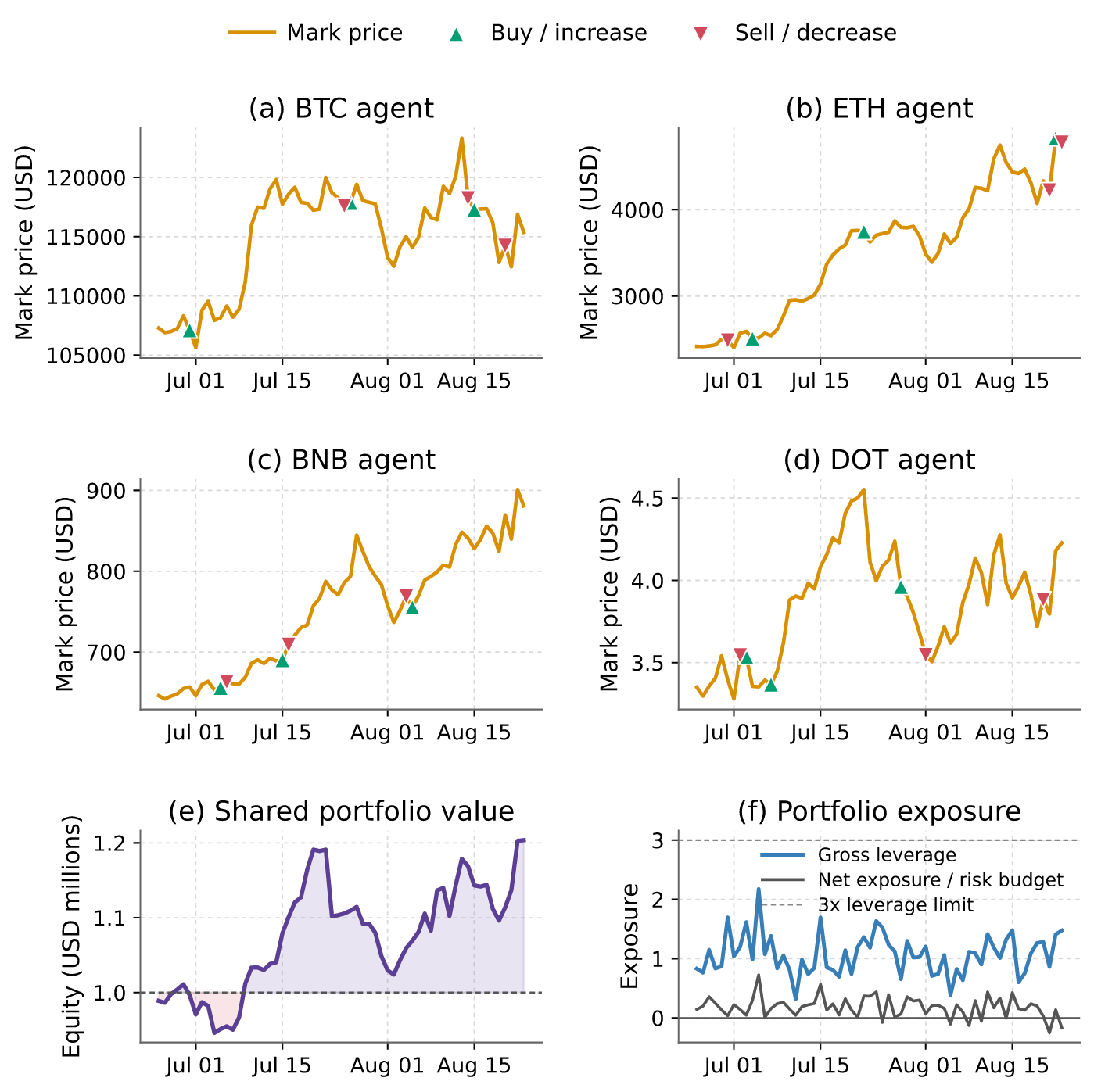
Cryptocurrency perpetual futures form a large-scale online financial market in which automated agents manage interacting asset positions under changing conditions. Policies relying solely on micro-level numerical states may overlook cross-asset relationships and become vulnerable to regime shifts, while macro-level linguistic judgments alone cannot ensure precise measurement or optimize positions under trading costs and risk constraints. Connecting market interpretation to coordinated multi-asset decisions remains challenging. We propose M3FT, a micro-macro-micro framework for multi-agent perpetual futures trading. The first micro stage constructs time-aligned numerical states from exchange and account observations through deterministic processing. The macro stage transforms these measured states into explicit market interpretations without adding external market information. Four asset-specific teams, each comprising a Market Interpreter, an Asset Communicator, and a Risk Reviewer, refine these interpretations through experience retrieval, cross-asset communication, and review of joint-position risks. The final micro stage combines encoded linguistic representations with the original numerical states to learn continuous target positions. We implement this framework with a language-conditioned multi-agent policy: asset actors use global and private numerical states together with linguistic context, while centralized critics evaluate joint actions using portfolio-wide information and shared-account rewards. Experiments on real cryptocurrency perpetual futures data, including comparisons across language models and policy-learning algorithms and component ablations, show that the best-performing M3FT configuration achieves a higher mean test return than the evaluated direct LLM, numerical RL, and rule-based baselines.
Citations and venue from Semantic Scholar (ODC-BY), refreshed weekly. Summary: Quant Letter (CC BY 4.0).