arXivEconometrics & Forecasting
Aggregate Calibration Can Mask Stress-State Undercoverage: Bounded-Memory Forecast Intervals under Recurrent Financial Stress
Aggregate forecast-interval coverage can hide state-specific failures when economic regimes return after long absence; recent-only calibration undercovers during high volatility despite meeting overall targets.
Featured in No. 138 on 6 Nov 2026 · 2 days after release
- Released
- 4 Nov 2026
- First featured
- No. 138 · 6 Nov 2026
- Published in
- Not yet, as far as Semantic Scholar knows
- Fanfare
- 2 of 5
- Identifier
- arXiv:2611.04223
- Authors
- Ruihang Han and Li-Hsiang Lin
Abstract
From arXiv (CC0).
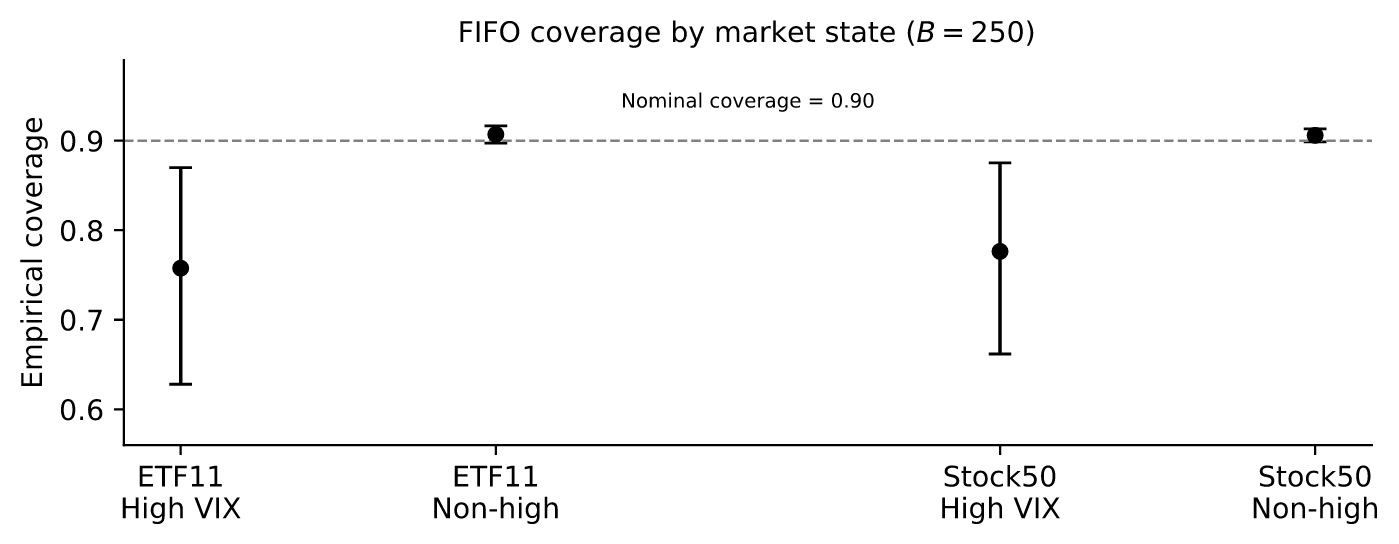
Sequential forecast intervals are often evaluated by aggregate coverage even when calibration memory is bounded. This can be misleading when economically important states recur after long absences: a recent-only buffer may satisfy its overall coverage target while no longer containing errors from earlier episodes of the returning state. We study this problem in next-day financial range forecasting, holding the forecasting model, conformity score, adaptive update, and memory budget constant while varying the historical residual information available at each query. Recent-only first-in, first-out (FIFO) calibration is near nominal in aggregate but undercovers substantially during high-volatility states in both an exchange-traded fund development panel and a fixed stock panel. An unbounded state-history reference yields a lower observed stress-period interval score; Rare replay yields lower high-VIX interval scores than the matched Recent-n and Hybrid-n controls in both panels, and the state-structured versus recent-only contrast is largest near stress re-entry. Bounded calibration memory is therefore part of the forecasting information design, and aggregate calibration alone can conceal state-specific reliability failures.
Citations and venue from Semantic Scholar (ODC-BY), refreshed weekly. Summary: Quant Letter (CC BY 4.0).