arXivML & AI Methods
LENS: Reliability-Aware Stock Prediction via LLM-Extracted Priors and News-Driven Semantic Graphs
A graph framework that weights extracted relations by reliability improves stock ranking on the S&P 500 by 16.4% in average recall and 22.6% in success rate.
Featured in No. 138 on 6 Nov 2026 · 2 days after release
- Released
- 4 Nov 2026
- First featured
- No. 138 · 6 Nov 2026
- Published in
- Not yet, as far as Semantic Scholar knows
- Fanfare
- 3 of 5
- Identifier
- arXiv:2611.04217
- Authors
- Hao Zhou et al.
Abstract
From arXiv (CC0).
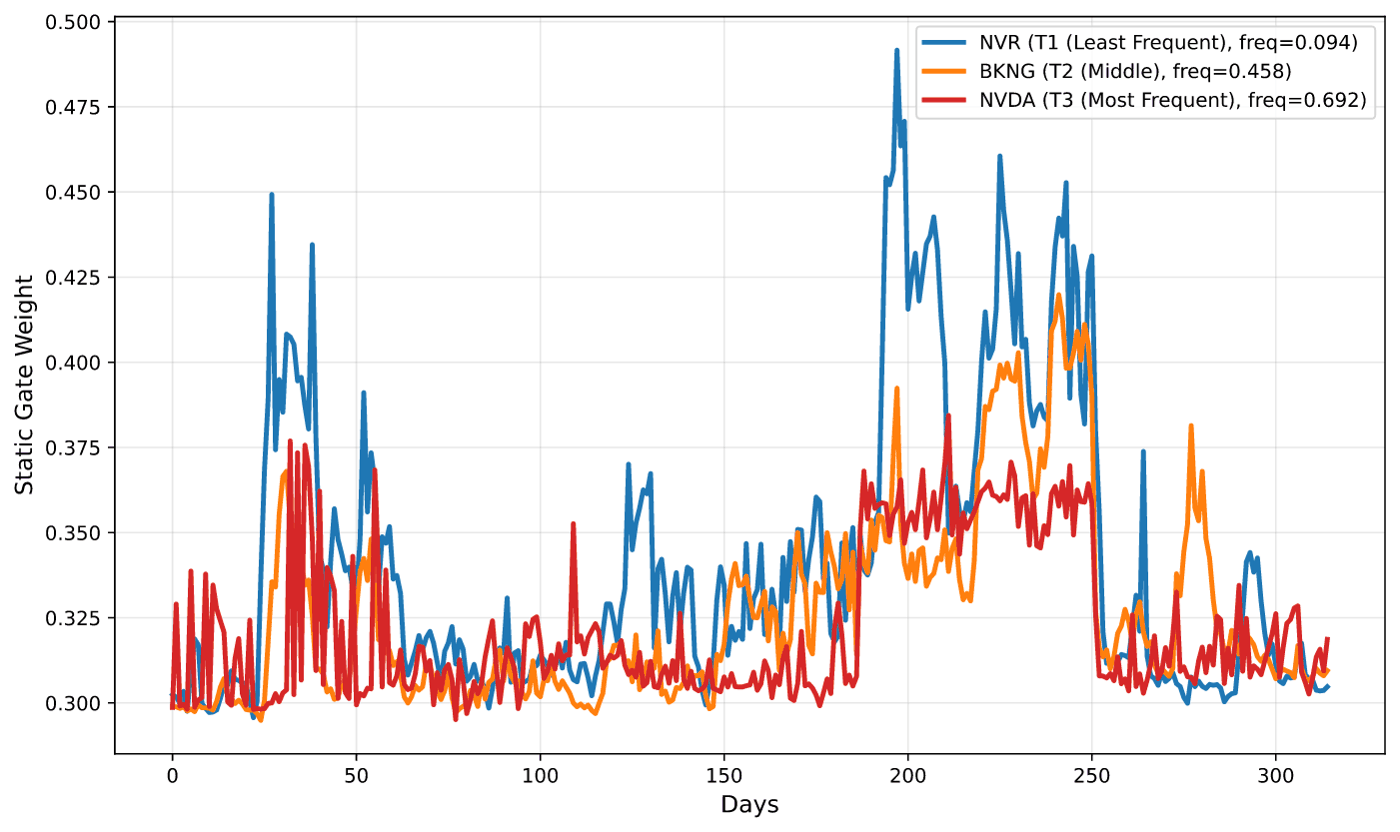
Predicting stock returns requires modeling persistent company relations and time-varying market signals. Graph Neural Network (GNN) approaches combine static priors with dynamic relational graphs, but treat every extracted edge as a trustworthy binary fact, ignoring heterogeneous reliability across relational sources. We propose LENS (LLM-Extracted priors and News-driven Semantics), a static--dynamic graph framework for stock return prediction and ranking that models relational reliability as a first-class signal across the pipeline. On the static side, we extract a multi-relational company graph from a Large Language Model and aggregate it over multiple runs with confidence weighting to downweight low-consistency edges. On the dynamic side, we build a news-driven semantic graph with exponential-decay temporal aggregation to capture changing market context under uneven coverage. A context-dependent gated fusion module rebalances the two graphs at the per-stock, per-day level. On S&P 500, LENS improves AR@5 by 16.4% and SR@5 by 22.6% over the strongest baseline, and on NASDAQ 100 it achieves comparable improvements (15.5% and 20.9% respectively). Ablations isolate each component's contribution, and a human-validation study of sampled relations supports that the aggregation is grounded, providing evidence that reliability-aware LLM relations and news-based semantic graphs carry complementary information for graph-based financial prediction.
Citations and venue from Semantic Scholar (ODC-BY), refreshed weekly. Summary: Quant Letter (CC BY 4.0).