arXivTrading, Microstructure & Execution
Can We Stop the Backtest Yet? Anytime-Valid Promotion Tests for Adaptive Financial Research Agents
A protocol using e-processes and Ville arguments lets researchers monitor candidates born at data-dependent times and adaptively chosen, bounding false promotion rates without a fixed sample size.
Featured in No. 138 on 6 Nov 2026 · 3 days after release
- Released
- 3 Nov 2026
- First featured
- No. 138 · 6 Nov 2026
- Published in
- Not yet, as far as Semantic Scholar knows
- Fanfare
- 3 of 5
- Identifier
- arXiv:2611.03384
- Authors
- Eric Benhamou et al.
Abstract
From arXiv (CC0).
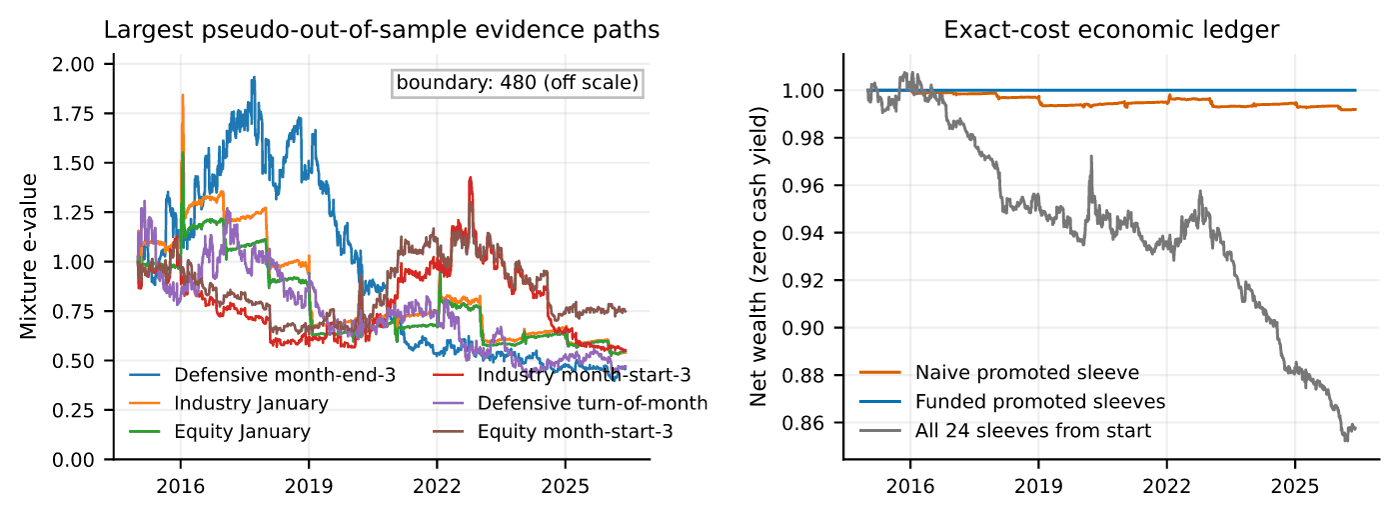
Financial research agents can generate and monitor trading rules faster than a human can document the resulting selection process. Candidates appear at data-dependent times, weak rules are abandoned, and promising ones are watched until they cross a reporting threshold. We introduce PROMOTE, a protocol that assigns every candidate predictable testing wealth at birth and accumulates a cost-aware e-process only from subsequent returns. If lifetime allocations sum to at most one, a weighted Ville argument bounds the probability of ever promoting a rule whose declared bounded net score has always had nonpositive conditional mean. The result permits dependent candidates, adaptive births, and indefinite monitoring. We audit the implementation in two settings. A retrospective pseudo-out-of-sample replay contains 24 panel--rule hypotheses, 3,000 shared-sign null paths, injected alternatives, and public ETF and industry data. Repeated unadjusted tests produce a family crossing in 94.5% of null paths, versus 0.0% for PROMOTE; at a 15-bp aligned ETF-component perturbation, PROMOTE has 70.1% target power and median crossing session 2,327. A separate exact mean-zero experiment lets an agent select candidate identities and birth times from past scores; the funded gate has 1.77% false-family crossings across 3,000 programs. The market replay produces zero promotions after costs. The certificate controls historical false promotion under the declared null; it is not a certificate that an earlier edge remains profitable at deployment. AI-use disclosure. Generative AI tools, including OpenAI Codex, assisted manuscript preparation. For this preprint version, Codex assisted with LaTeX editing, author and venue metadata, compilation, and layout checks.
Citations and venue from Semantic Scholar (ODC-BY), refreshed weekly. Summary: Quant Letter (CC BY 4.0).