Expected shortfall estimation and capital coverage under overlapping scenarios
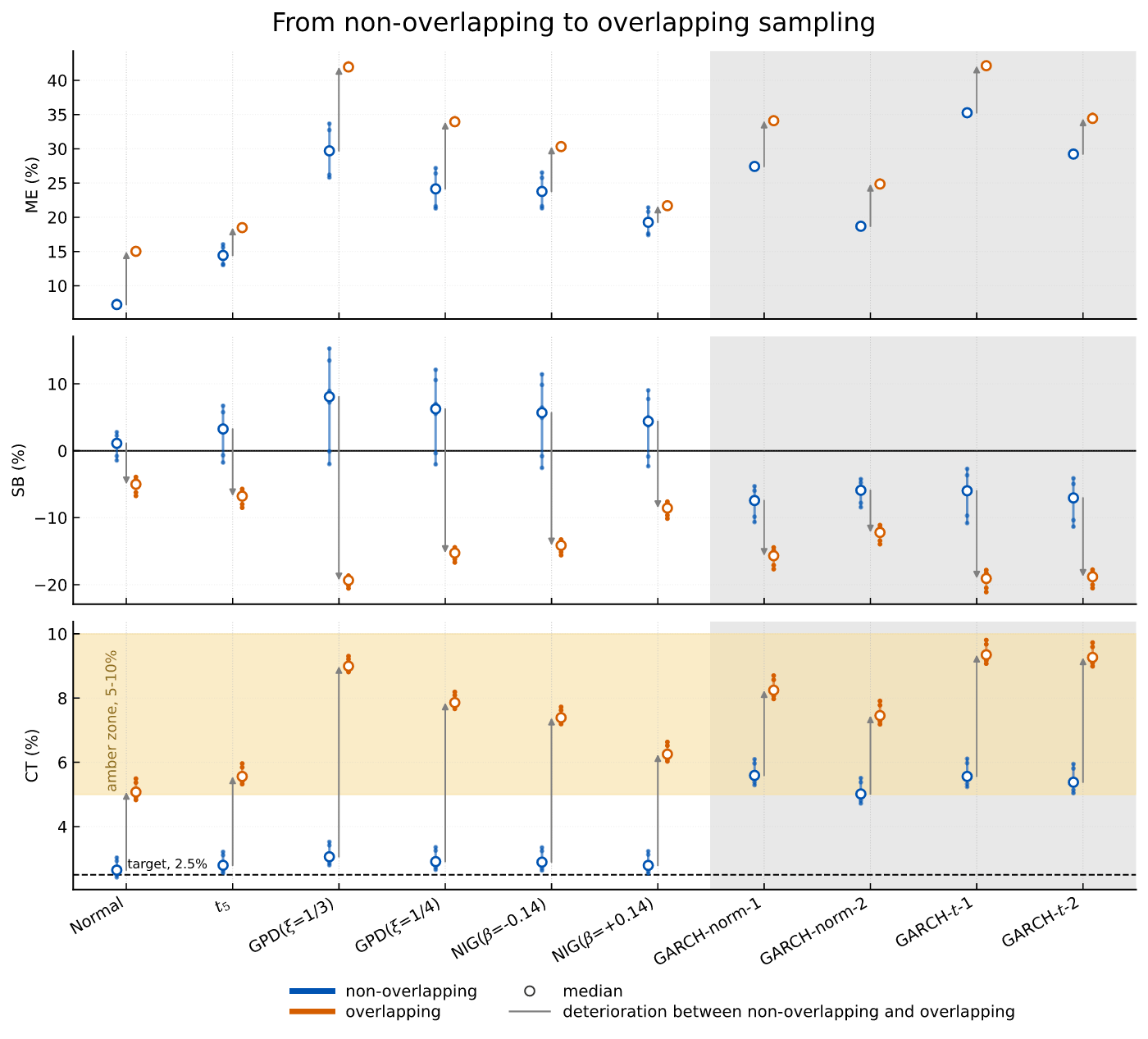
When estimating expected shortfall from overlapping multi-day returns, the mismatch with standard independent-sampling theory causes systematic downward bias that weakens capital coverage, especially under heavy tails.
Featured in No. 138 on 6 Nov 2026 · 4 days after release
- Released
- 2 Nov 2026
- First featured
- No. 138 · 6 Nov 2026
- Published in
- Not yet, as far as Semantic Scholar knows
- Fanfare
- 3 of 5
- Identifier
- arXiv:2610.41624
- Authors
- Martin Aichele et al.
Abstract
From arXiv (CC0).
Expected shortfall (ES) is routinely estimated from a short sample of profit-and-loss (P&L) scenarios built from overlapping multi-day returns, while the non-parametric estimators applied to such data are designed under independent sampling. We study how this mismatch affects estimation accuracy and capital coverage, and how it interacts with serial dependence and heavy tails in the underlying P&L. Working within the coherent risk estimation framework, we compare six order-statistic-based ES estimators on fit, bias, and capital-coverage metrics. Following the Fundamental Review of the Trading Book (FRTB), we use a one-year estimation window and ES at the $2.5\%$ confidence level as a benchmark setup. We combine simulations with market data on twelve risk factors and ninety-nine equity portfolios. We show that overlapping sampling does not merely add noise but shifts ES estimates systematically downward, thereby weakening capital coverage. Serial dependence acts in the same direction, and heavy tails amplify both effects. More conservative weighting mitigates the underestimation but does not remove it. On market data, the confidence level at which the estimated capital covers realized losses roughly doubles in median under overlapping sampling for every estimator, while the $\textrm{ES}_{2.5\%}$-to-$\textrm{VaR}_{1\%}$ ratio, which links the FRTB base market risk capital metric to its pre-FRTB predecessor, changes comparatively little. Overlapping sampling can thus substantially understate ES-based capital. Since many banks apply a small set of standard estimators in their FRTB regulatory or economic capital model in a historical simulation approach, this understatement is likely to be common for many institutions, and combining simulation-based assessment of estimation risk with coverage-based diagnostics offers a practical method to detect it in model validation and monitoring.
Citations and venue from Semantic Scholar (ODC-BY), refreshed weekly. Summary: Quant Letter (CC BY 4.0).