arXivTrading, Microstructure & Execution
Intraday Forecasting Ability and Liquidity Provision of Institutional Traders
High-frequency data shows skillful traders have persistent predictive edge; one-standard-deviation improvement in forecasting ability raises position P&L by 1.02–1.19 units.
Featured in No. 136 on 23 Oct 2026 · on release day
- Released
- 23 Oct 2026
- First featured
- No. 136 · 23 Oct 2026
- Published in
- Not yet, as far as Semantic Scholar knows
- Fanfare
- 2 of 5
- Identifier
- arXiv:2610.31141
- Authors
- Xinlei Hao et al.
Abstract
From arXiv (CC0).
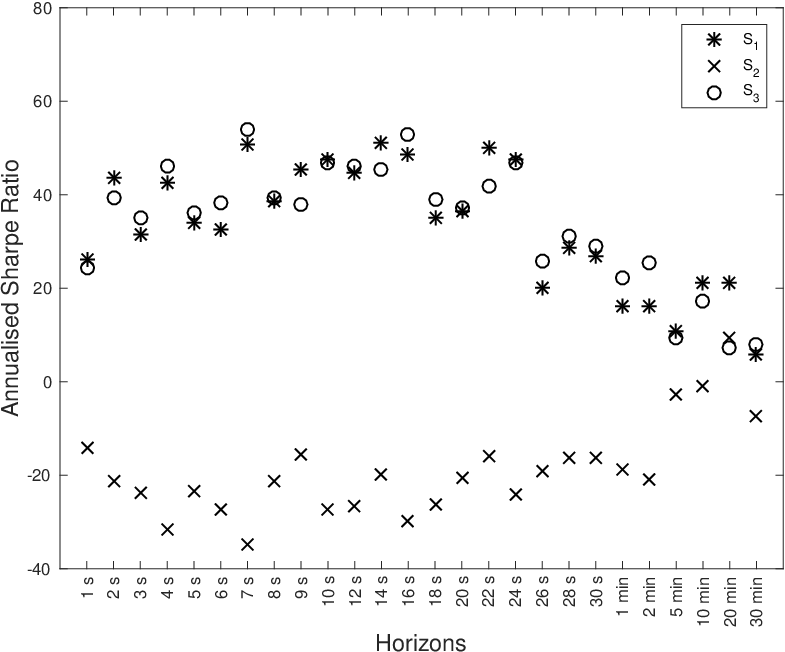
This study uses a high-frequency dataset from a stock exchange to examine how forecasting ability and liquidity provision relate to institutional traders' proprietary intraday profitability. We discover persistent forecasting abilities among traders. Specifically, we demonstrate that hypothetical flow-following strategies based on the execution flows of these skillful traders yield annualized Sharpe ratios ranging from 16 to 63 across various trading frequencies. We match buy and sell executions into positions, linking realized profit and loss (P&L) to horizon-matched forecasting proxies and the liquidity roles of both executions. Our findings indicate a direct correlation between improved forecasting ability and profitability, where a one-standard-deviation increase in the forecasting ability proxy is associated with 1.02 -- 1.19 currency units higher P&L per matched position. Additionally, we measure liquidity-provision intensity within a matched position by its number of passive executions: zero, one, or two. In these regressions, P&L is 1.28 -- 1.31 currency units higher for one passive execution than for none, and a further 3.79 -- 3.82 higher for two than for one, underscoring the significant financial benefits of liquidity provision.
Citations and venue from Semantic Scholar (ODC-BY), refreshed weekly. Summary: Quant Letter (CC BY 4.0).