arXivML & AI Methods
Lineage-Aware Search Control for LLM-Based Evolutionary Factor Mining
LineageEvo guides large-language-model-based alpha factor search using lineage-conditioned variation and stratified allocation, promoting diverse and predictive factor discovery.
Featured in No. 136 on 23 Oct 2026 · 1 day after release
- Released
- 22 Oct 2026
- First featured
- No. 136 · 23 Oct 2026
- Published in
- Not yet, as far as Semantic Scholar knows
- Fanfare
- 2 of 5
- Identifier
- arXiv:2610.29663
- Authors
- Xintong Liu et al.
Abstract
From arXiv (CC0).
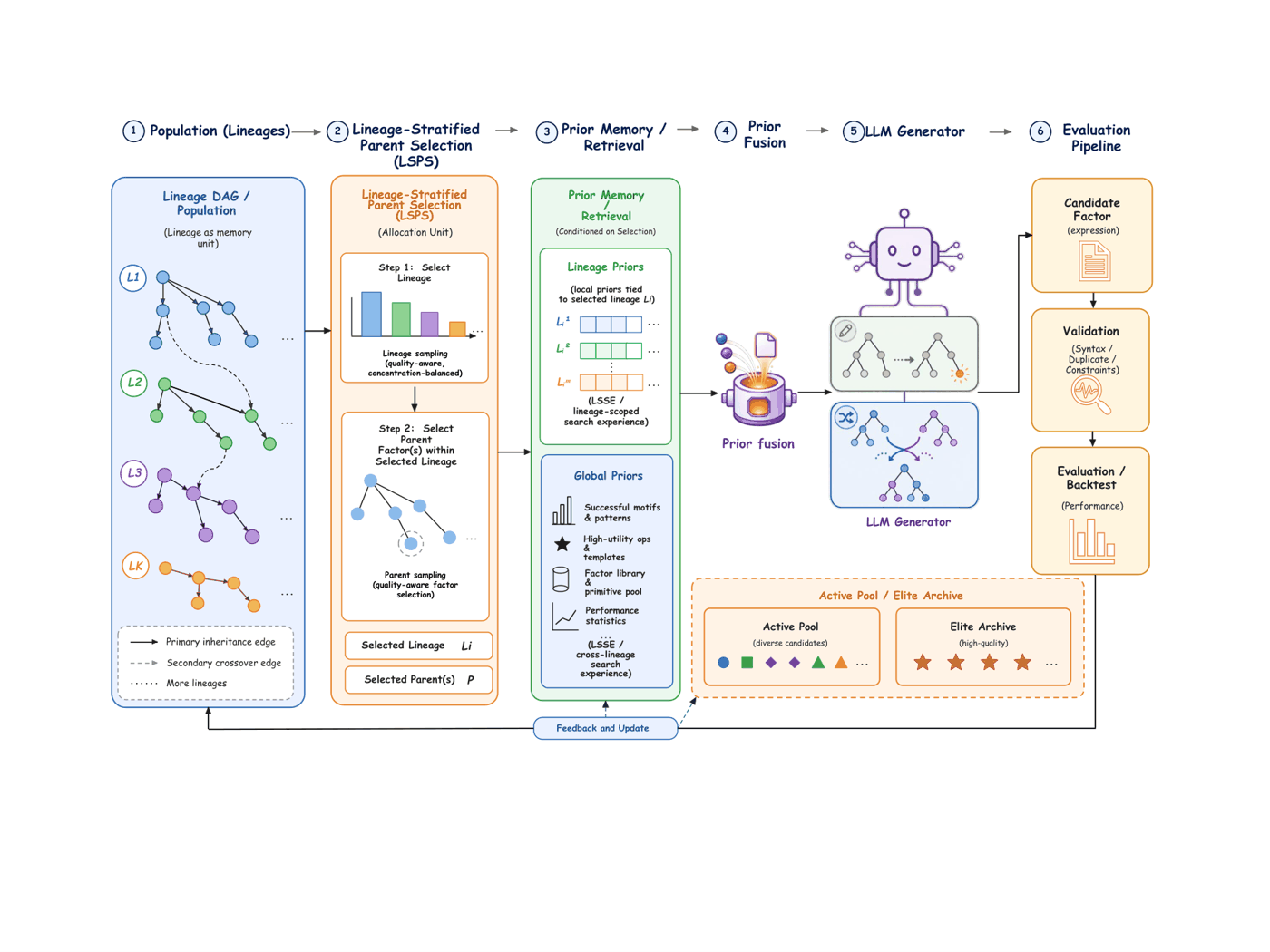
Formulaic alpha factor mining searches for symbolic expressions that transform market data into predictive signals. Recent LLM-based evolutionary factor mining methods use large language models as semantic variation operators. Under the conventional LLM-EA paradigm, stochastic variation and fitness-based selection can leave the search weakly directed and concentrated around a narrow set of structurally similar factors. We argue that these limitations arise because current methods mainly organize search at the individual and population levels, leaving lineage-level control underused. A lineage connects successive factor variants through evolutionary descent. We propose LineageEvo, which uses lineage in two coupled forms of search control: (1) lineage-conditioned LLM variation, which distills Lineage-Scoped Search Experience into operator-specific priors and fuses them with global operator priors, providing persistent, lineage-relevant guidance for LLM generation; and (2) lineage-stratified search allocation, which balances factor quality against lineage concentration by distributing the search budget across lineages during evolutionary search. Together, these mechanisms make semantic variation more direction aware and prevent branches from dominating the evolution, thereby promoting the discovery of predictive and diverse factors. We evaluate LineageEvo on CSI 500 and S&P 500 in terms of factor predictiveness, portfolio performance, search efficiency, and lineage- and expression-level diversity. LineageEvo achieves the strongest predictive performance on both markets, while LSPS produces a more balanced lineage distribution and a structurally broader factor pool. The results support lineage as a useful intermediate unit for controlling LLM-based evolutionary factor search.
Citations and venue from Semantic Scholar (ODC-BY), refreshed weekly. Summary: Quant Letter (CC BY 4.0).