arXivEconometrics & Forecasting
Deep-$π^*$: A Neural Network Estimate of Trend Inflation
Deep-π* attributes trend inflation movements to macroeconomic indicators via neural networks, forecasting inflation more accurately than classical models and signaling the 2021 surge earlier.
Featured in No. 136 on 23 Oct 2026 · 3 days after release
- Released
- 20 Oct 2026
- First featured
- No. 136 · 23 Oct 2026
- Published in
- Not yet, as far as Semantic Scholar knows
- Fanfare
- 3 of 5
- Identifier
- arXiv:2610.26298
- Authors
- Carlos Montes-Galdón
Abstract
From arXiv (CC0).
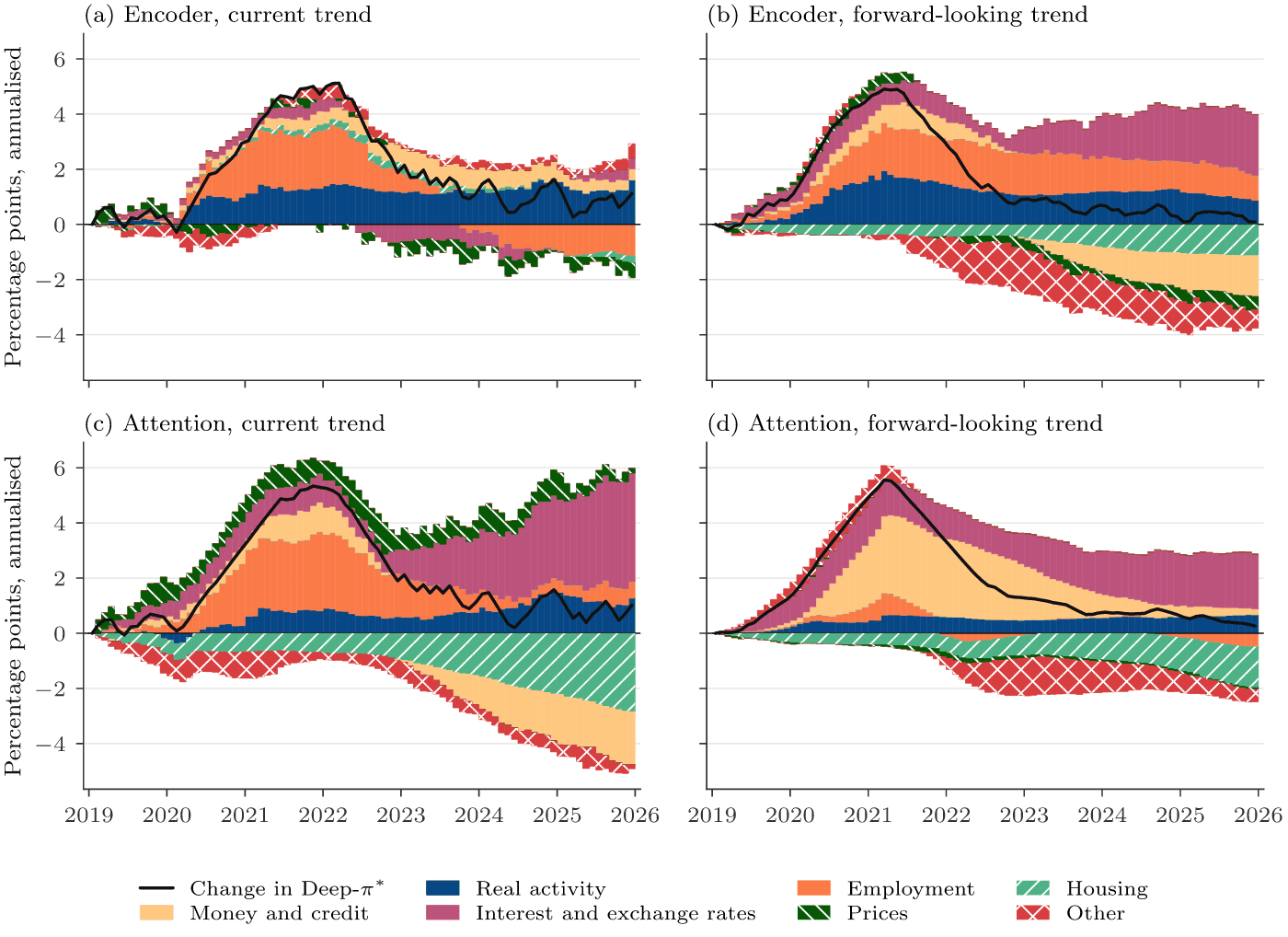
Most empirical models of trend inflation treat it as a latent random walk driven by unobserved shocks, so they cannot say which economic conditions move it. Deep-$π^*$ makes the innovations to the trend a possibly nonlinear function of a large number of macroeconomic indicators, estimated with neural networks, so that Shapley values can be used to attribute every movement of the trend to the indicators behind it. Two complementary loss functions define a current trend, which fits inflation today, and a forward-looking trend, which best predicts inflation over the next year. In US data, employment-related variables were the largest contributors to the post-pandemic rise of the current trend. However, the forward-looking trend rose earlier, with real activity, employment, and money and credit as the main drivers, and peaked eight to twelve months before the current trend. Both trends looked through most of the movements in energy and commodity prices. The contributions of the indicators are nonlinear, with sizeable interactions between them. Re-estimated every month during the surge, the model forecast inflation more accurately than the standard UC-SV model and a random walk, and in early 2021, when professional forecasters expected inflation of 3% or less, the forward-looking trend was already signalling an increase in persistent inflation.
Citations and venue from Semantic Scholar (ODC-BY), refreshed weekly. Summary: Quant Letter (CC BY 4.0).