Conflicting History in Foundation Model Return Forecasts
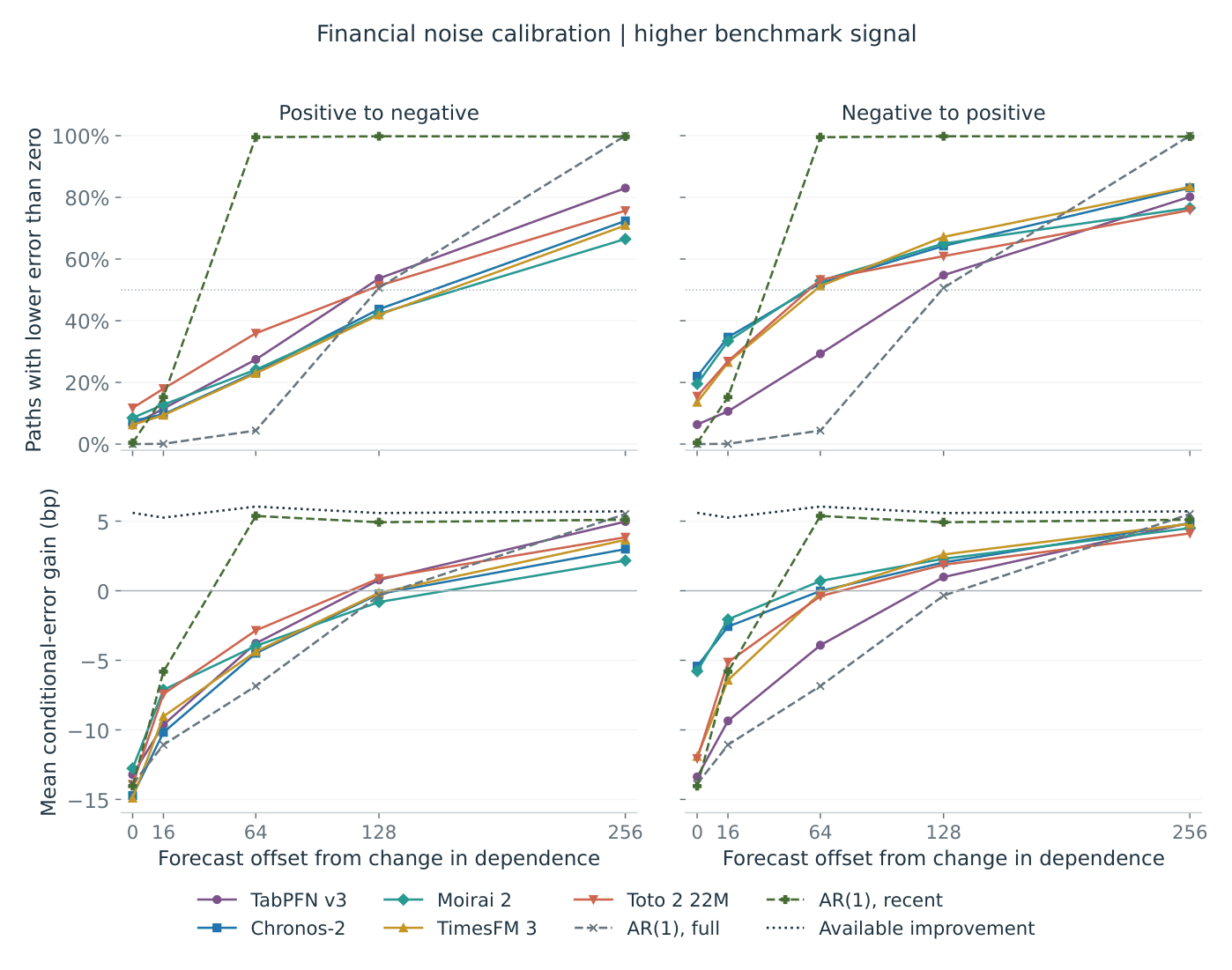
Older observations that conflict with recent data reduce foundation models' probability of beating zero across all tested procedures, distinguishing signal extraction from conflicting-history resistance.
Featured in No. 136 on 23 Oct 2026 · 3 days after release
- Released
- 20 Oct 2026
- First featured
- No. 136 · 23 Oct 2026
- Published in
- Not yet, as far as Semantic Scholar knows
- Fanfare
- 2 of 5
- Identifier
- arXiv:2610.25822
- Authors
- Levent Bulut
Abstract
From arXiv (CC0).
Older observations can help a forecaster learn a predictive relationship while becoming misleading when that relationship changes. We study this tension using paired return histories that differ in older observations but share recent returns and the conditional distribution of the next return. Across five foundation-model forecasting procedures and three simulated processes, each evaluated on 1,024 independent replications, conflicting history reduces the probability of improving on zero in all 30 higher-signal comparisons. This loss of usefulness occurs despite successful signal recovery under stable conditions. A separate exploratory comparison on 56 assets finds that shortening inputs from 256 to 64 returns increases mean absolute error for every model by 1.77-4.58 basis points; neither length improves observed overall error over zero. The evidence distinguishes the ability to extract a signal from the ability to withstand conflicting history, while showing why context sensitivity alone does not justify discarding older data.
Citations and venue from Semantic Scholar (ODC-BY), refreshed weekly. Summary: Quant Letter (CC BY 4.0).