Amortized Neural Filtering for Calibrated Posteriors in Statistical Arbitrage
A neural filter estimates posterior uncertainty over spread states and uses it to size positions, cutting the gap between forecasted and realized returns by two to eight times on Korean equities.
Featured in No. 136 on 23 Oct 2026 · 3 days after release
- Released
- 20 Oct 2026
- First featured
- No. 136 · 23 Oct 2026
- Published in
- Not yet, as far as Semantic Scholar knows
- Fanfare
- 3 of 5
- Identifier
- arXiv:2610.25802
- Authors
- Minkey Chang
Abstract
From arXiv (CC0).
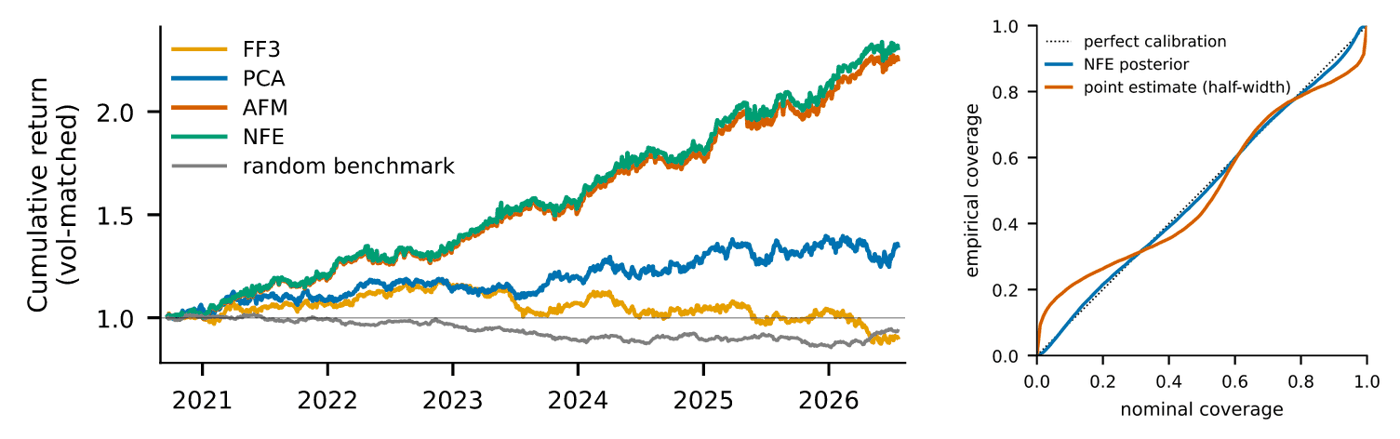
Statistical arbitrage trades on an estimate of the state of a residual spread, and conventional practice discards the uncertainty of that estimate. We keep the uncertainty and use it in the trading decision. A Neural Filter Estimator (NFE) is trained on simulated paths of a mean-reverting process whose innovation law is selected by testing candidates against real residuals; once trained, it returns the posterior over the latent state of every spread in a cross-section in one forward pass. Three results follow. On simulated paths with known truth, every practical estimator, ours included, falls in one narrow band of accuracy well below an estimator given full information, so the posterior gains no accuracy over a point estimate; its contribution is a correct account of its own uncertainty. On Korean equities, net of costs, the conventional point estimate forecasts about a thousand basis points per holding period more than it realizes, and the amortized methods cut that gap by a factor of roughly two to eight. Sizing positions from the posterior on the same learned factors as the end-to-end Attention Factor Model matches the Sharpe ratio of those factors under the base rule within the period's noise, at no more risk.
Citations and venue from Semantic Scholar (ODC-BY), refreshed weekly. Summary: Quant Letter (CC BY 4.0).