arXivLLMs & Text
From SEC Filings to Financial Signals: Evaluating LLMs on Stock Market Reactions and Analyst Forecasts
Analysis of 13 language models on 45,964 Form 10-Q filings shows finance-specialized models produce modest advantages in return ranking but lag analyst consensus in earnings forecasts.
Featured in No. 136 on 23 Oct 2026 · 3 days after release
- Released
- 20 Oct 2026
- First featured
- No. 136 · 23 Oct 2026
- Published in
- Not yet, as far as Semantic Scholar knows
- Fanfare
- 2 of 5
- Identifier
- arXiv:2610.24268
- Authors
- Shengkun Wang et al.
Abstract
From arXiv (CC0).
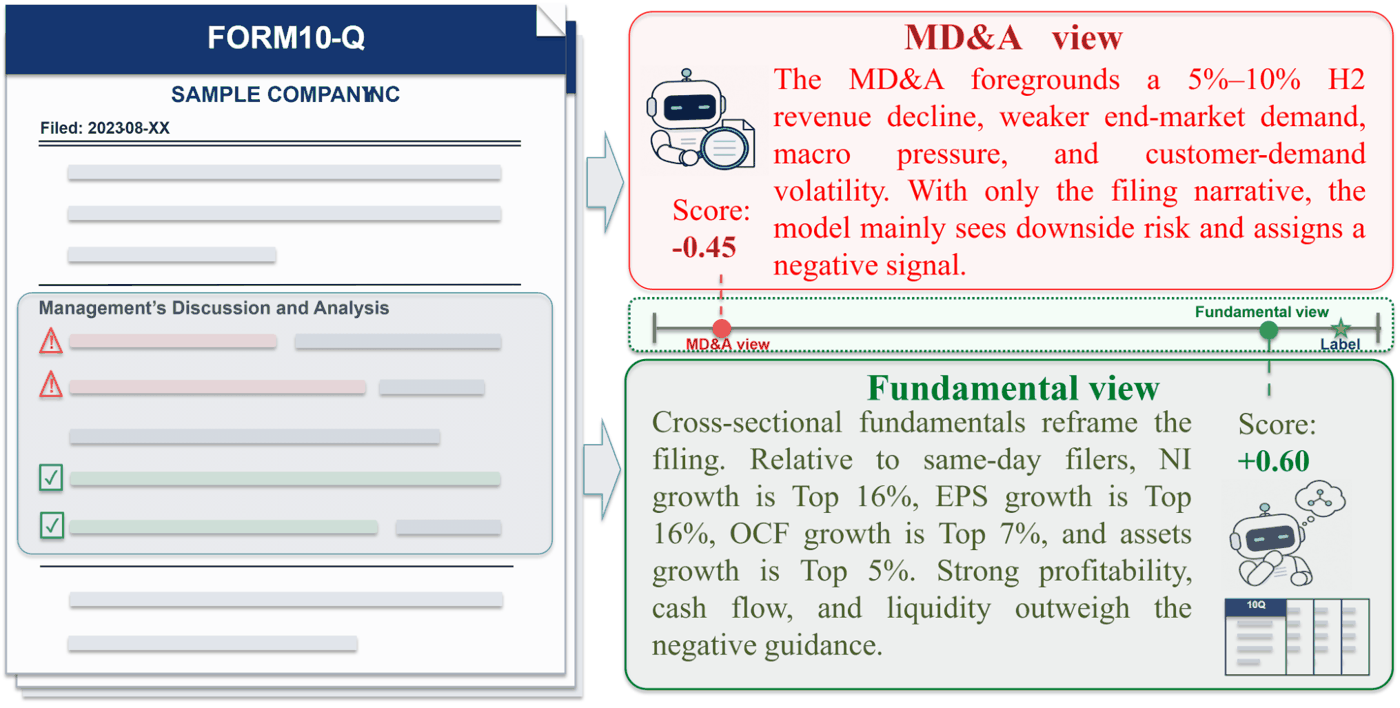
Form 10-Q MD&A sections combine long-form management narrative with accounting and forward-looking information. Benchmarks for financial filings commonly evaluate question answering or numerical reasoning, leaving unclear whether outputs from large language models (LLMs) align with market and analyst outcomes. We evaluate prompted, zero-shot outputs from 13 general-purpose and finance-specialized LLMs on 45,964 Form 10-Q filing events from 2001 to 2024, linking MD&A text to cross-sectional fundamental ranks, pre-filing analyst forecasts, and realized abnormal returns. The evaluation covers return ranking under five controlled information views and next-quarter EPS forecasting under direct and consensus-anchored interfaces. Relative to disclosure alone, adding cross-sectional fundamental ranks raises mean effective-date rank correlation (RankIC) by 0.0089 for effective-event-date returns and 0.0098 for following-day returns, whereas analyst-summary context provides no comparable average gain. Across the four disclosure-containing views, finance-specialized models show an effective-event-date group advantage but no statistically reliable following-day advantage, while general-purpose Qwen models produce the strongest individual return-ranking results. Under the full-information view, direct LLM forecasts average the 43.4th percentile of the analyst distribution and do not consistently beat individual analysts. Consensus anchoring raises the mean inside-range share from 41.1% to 59.5% but increases reported-EPS error.
Citations and venue from Semantic Scholar (ODC-BY), refreshed weekly. Summary: Quant Letter (CC BY 4.0).