arXivCrypto & DeFi
Market Efficiency in a Changing Asset Population: Mobility, Entry, and Survival over Cryptocurrency's Full History
Testing weak-form efficiency on 8,970 cryptocurrencies over thirteen years, the study finds persistent asymmetry in market ranking but reveals that neglected assets lack liquidity rather than predictability.
Featured in No. 136 on 23 Oct 2026 · 4 days after release
- Released
- 19 Oct 2026
- First featured
- No. 136 · 23 Oct 2026
- Published in
- Not yet, as far as Semantic Scholar knows
- Fanfare
- 3 of 5
- Identifier
- arXiv:2610.23283
- Authors
- Antonis Ballis and Christos Ioannidis
Abstract
From arXiv (CC0).
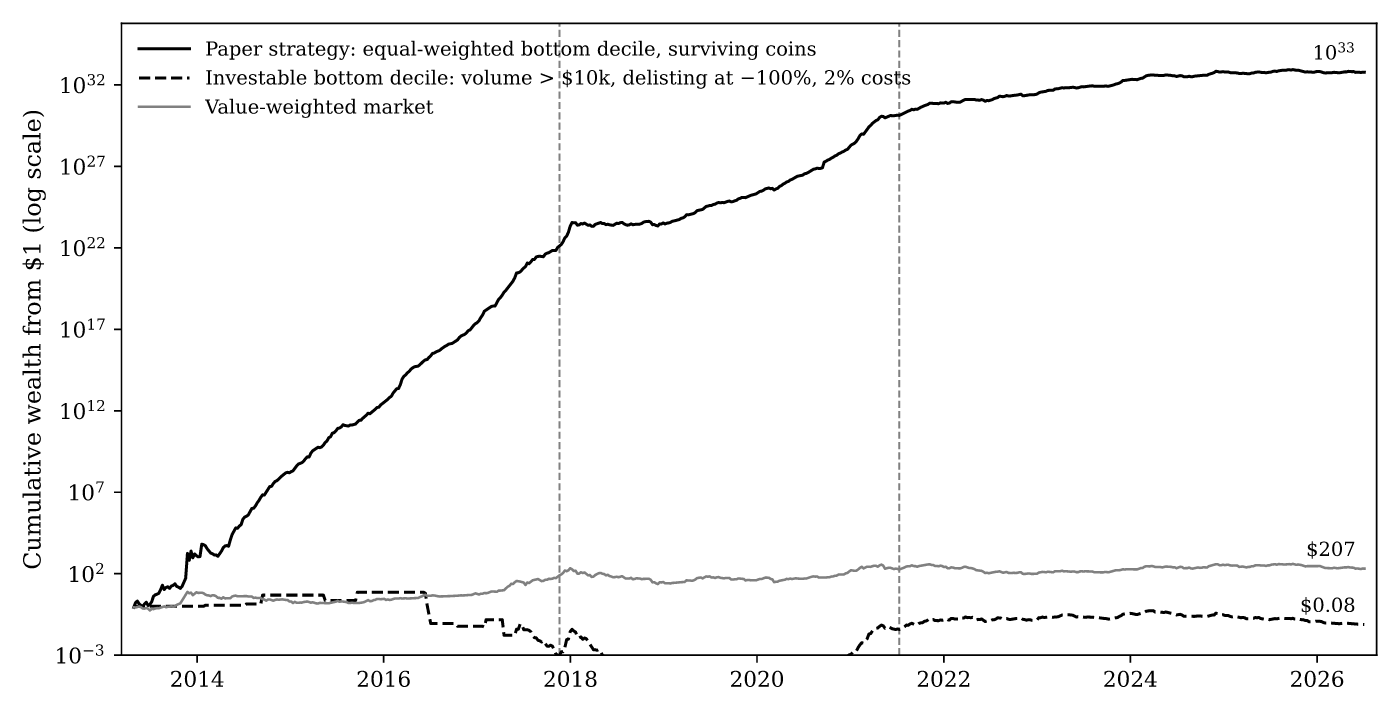
Weak-form efficiency implies symmetry restrictions on the Markov chain governing movement across the cryptocurrency capitalisation distribution. We test them on the full listed population: 8,970 assets, 690 weekly cross-sections, 2013 to 2026, with entry, exit and survival observed rather than inferred. Symmetry is rejected in every era, but the asymmetry falls by seventy percent, and what converged is entry-driven compositional churn rather than coins' own valuations. The bottom decile earns 27.5% per week on paper and nothing among assets that trade, on capacity of $293,000. Compensation for neglect exists precisely where trading does not.
Citations and venue from Semantic Scholar (ODC-BY), refreshed weekly. Summary: Quant Letter (CC BY 4.0).