arXivML & AI Methods
Bayesian Optimization of CVaR with Unknown Hyperparameters
HE-CV-UCB adaptively eliminates misspecified surrogate models and achieves no-regret Conditional-Value-at-Risk optimization when kernel hyperparameters are unknown.
Featured in No. 135 on 16 Oct 2026 · 2 days after release
- Released
- 14 Oct 2026
- First featured
- No. 135 · 16 Oct 2026
- Published in
- Not yet, as far as Semantic Scholar knows
- Fanfare
- 3 of 5
- Identifier
- arXiv:2610.18306
- Authors
- Valentin Margraf et al.
Abstract
From arXiv (CC0).
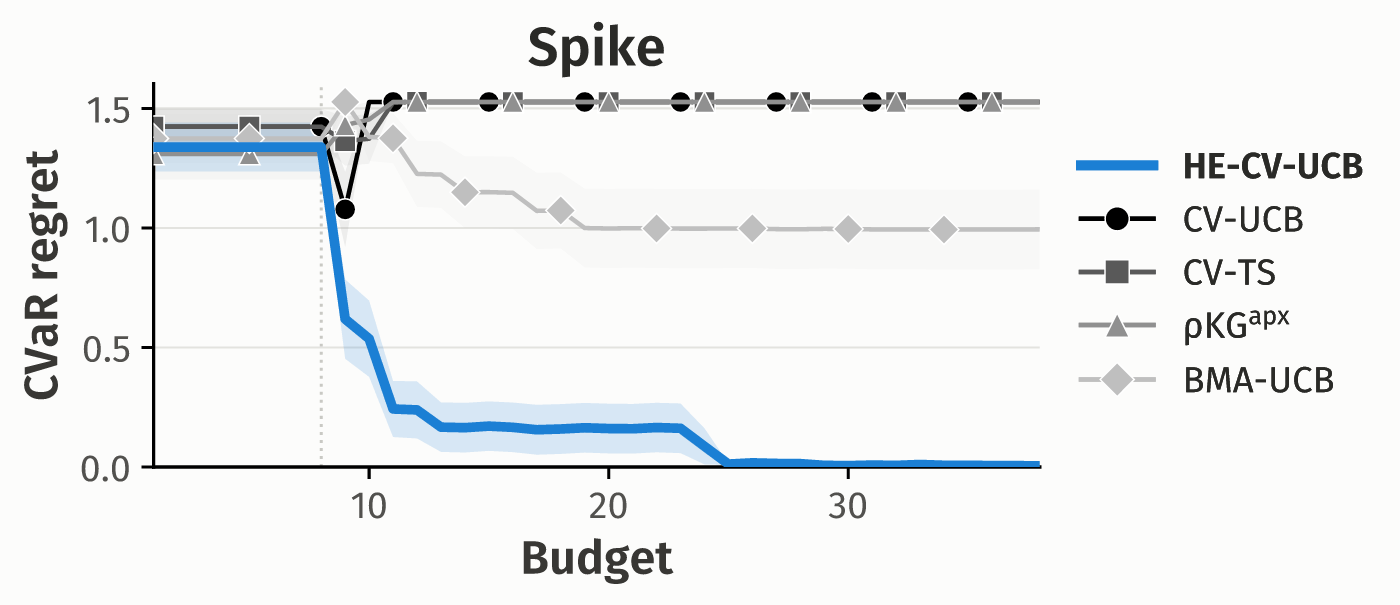
We study Bayesian optimization of the Conditional Value-at-Risk (CVaR) of an expensive black-box function that depends on a decision and an environmental variable. Existing no-regret algorithms assume that the correct Gaussian process (GP) kernel and its hyperparameters are known. In practice, however, they must be estimated from limited data, often yielding a misspecified surrogate. This is especially damaging for CVaR because misspecification can distort the estimated tail-risk and thus lead to catastrophic decisions. We propose HE-CV-UCB, the first no-regret algorithm for CVaR Bayesian optimization with unknown GP hyperparameters. Given a finite candidate set containing a well-specified model, HE-CV-UCB adaptively eliminates those inconsistent with the observed data, actively queries where the survivors disagree, and returns a design that is robust across the surviving candidates. We prove that it attains cumulative regret matching the oracle rate of CV-UCB up to a factor depending only on the candidate set's size. Across synthetic benchmarks and three real-world applications, HE-CV-UCB achieves competitive performance and frequently outperforms existing CVaR Bayesian optimization methods.
Citations and venue from Semantic Scholar (ODC-BY), refreshed weekly. Summary: Quant Letter (CC BY 4.0).