arXivML & AI Methods
AlphaRLM: Aligning Language Models for Literature-Grounded Symbolic Factor Discovery
An reinforcement-learning framework trains language models to construct executable symbolic factors from financial literature, aligned via market feedback, outperforming baselines on Chinese and U.S. equity indices.
Featured in No. 135 on 16 Oct 2026 · 2 days after release
- Released
- 14 Oct 2026
- First featured
- No. 135 · 16 Oct 2026
- Published in
- Not yet, as far as Semantic Scholar knows
- Fanfare
- 3 of 5
- Identifier
- arXiv:2610.14959
- Authors
- Jie Huang et al.
Abstract
From arXiv (CC0).
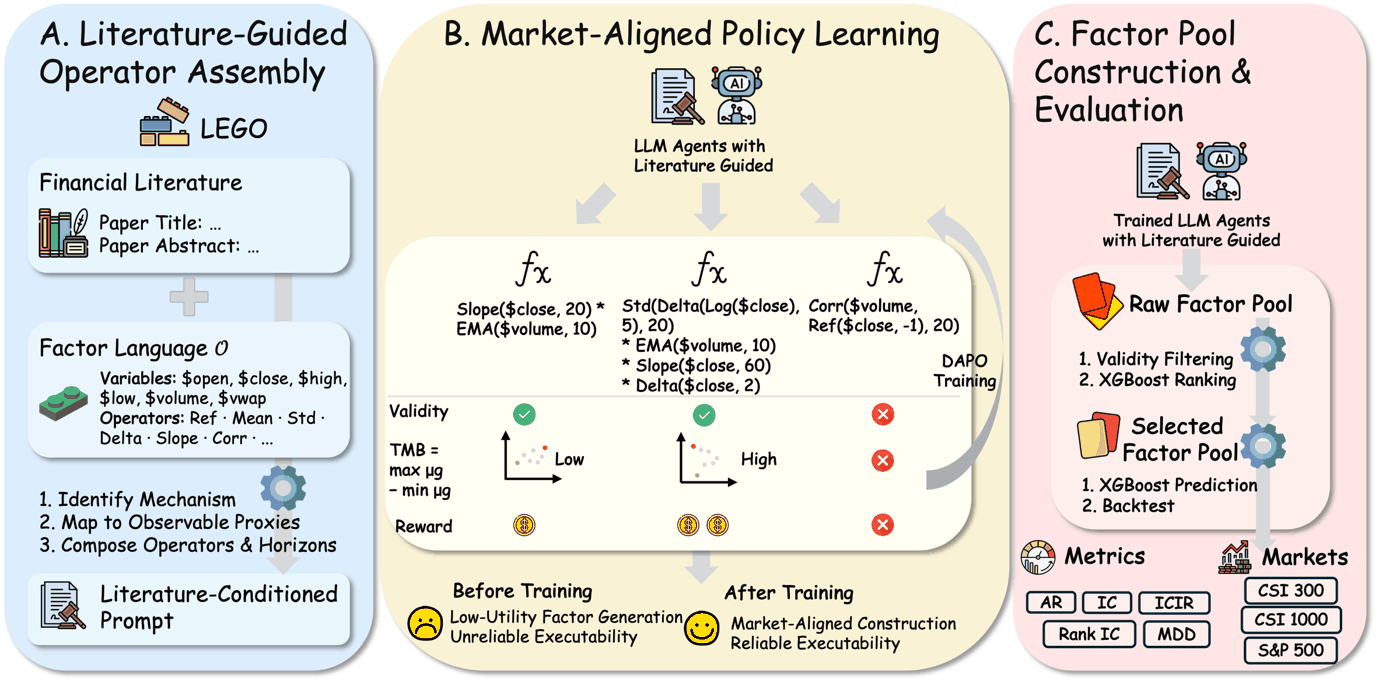
Formulaic alpha mining seeks to discover executable expressions that capture predictive market signals in a vast, noisy search space. Recent LLM-based approaches use prompting, iterative search, or seed-factor evolution, leaving direct factor construction through policy learning less explored. To address this, we introduce AlphaRLM, a reinforcement-learning framework that trains LLMs to construct executable symbolic factors from financial literature without input factor expressions. AlphaRLM incorporates Literature-Guided Operator Assembly (LEGO), which conditions factor construction on literature-derived ideas and executable operators, providing semantic priors for exploration. It further aligns the generation policy with market feedback through executable-validity and grouped-return-separation rewards that capture non-monotonic structures across factor quantiles. Extensive experiments on CSI 300, CSI 1000, and S&P 500 show that AlphaRLM outperforms strong factor-mining and LLM-based baselines in annualized excess return. Notably, the 8B model achieves strong cross-market performance, highlighting the promise of literature-conditioned, market-aligned factor generation.
Citations and venue from Semantic Scholar (ODC-BY), refreshed weekly. Summary: Quant Letter (CC BY 4.0).