Early Detection of Pension-Sponsor Distress from Public Filings: A Sponsor Vulnerability Index, Stress-Augmented VaR, and Dynamic Self-Investment Caps
A gradient-boosted classifier predicts pension sponsor distress one to two quarters ahead from SEC filings, reaching 0.887 AUC-ROC, with application to dynamic self-investment caps in sponsor securities.
Featured in No. 135 on 16 Oct 2026 · 2 days after release
- Released
- 14 Oct 2026
- First featured
- No. 135 · 16 Oct 2026
- Published in
- Not yet, as far as Semantic Scholar knows
- Fanfare
- 3 of 5
- Identifier
- arXiv:2610.14120
- Authors
- Ravil Akhtyamov
Abstract
From arXiv (CC0).
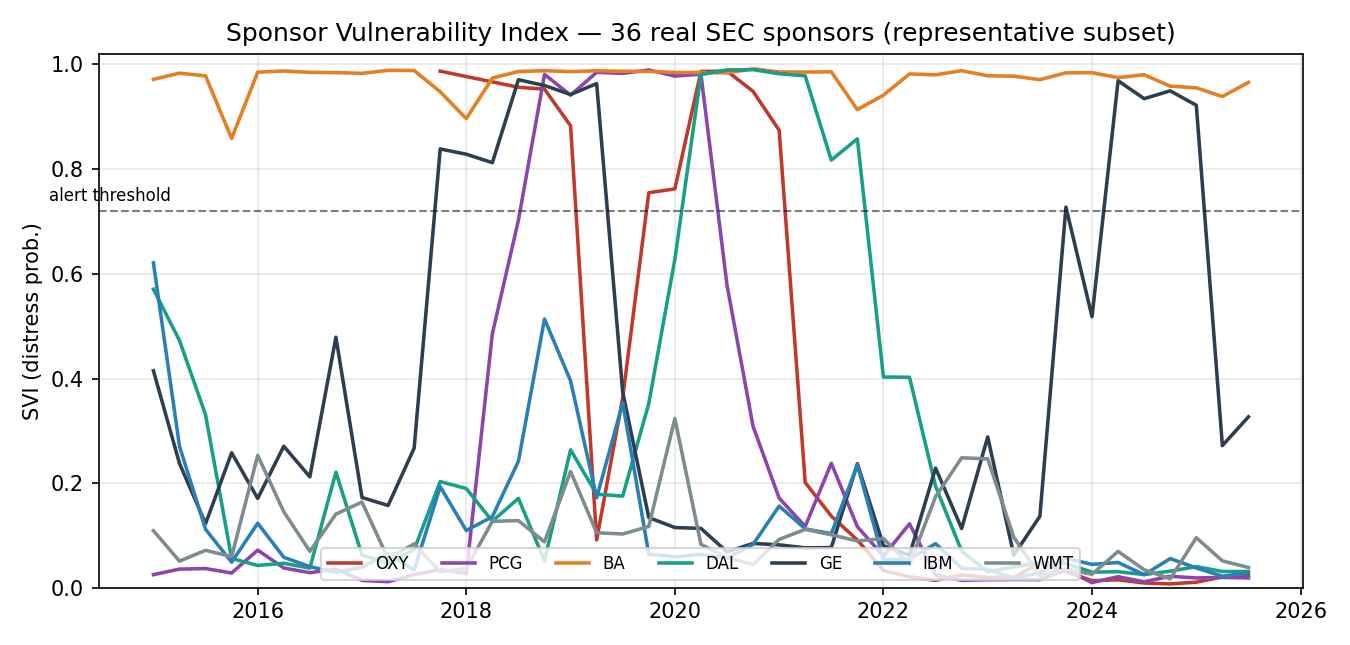
A defined-benefit pension is only as safe as its sponsor, yet sponsor distress is under-instrumented relative to plan-side modelling. We present a transparent, reproducible early-warning pipeline built entirely on public data. A Sponsor Vulnerability Index (SVI), a gradient-boosted classifier over point-in-time SEC EDGAR balance-sheet fundamentals and two macro series, predicts a filings-based distress state one to two quarters ahead. On 36 U.S. sponsors in five sector groups (1,418 firm-quarters, 2015Q1-2025Q3) it reaches an out-of-fold AUC-ROC of 0.887 and PR-AUC of 0.711 (base rate 11.9%) under leave-one-firm-out cross-validation. A Monte Carlo VaR with a stylized transition-stress overlay shows that climate-type stress is negligible for a diversified plan but adds 20-43% to one-year 95% VaR when 22.5% of assets are held in sponsor securities. A dynamic self-investment cap maps the SVI to a limit that falls from 8% to below 1% in acute distress and recovers with the sponsor, which we illustrate on PG&E's 2019 bankruptcy and Boeing's persistent fragility. We report the method's failure modes alongside its results (book-equity labels that also fire on non-credit events such as spin-offs, positives concentrated in one firm, and stylized stress parameters) and release code, data and results under a concept DOI.
Citations and venue from Semantic Scholar (ODC-BY), refreshed weekly. Summary: Quant Letter (CC BY 4.0).