arXivML & AI Methods
CorrFlow: Exact and Permutation-Equivariant Flow Matching on the Correlation Elliptope
A generalized Fisher transform and permutation-equivariant flow-matching network generate valid correlation matrices with 100% validity and superior feature distances versus GAN and diffusion baselines.
Featured in No. 135 on 16 Oct 2026 · 4 days after release
- Released
- 12 Oct 2026
- First featured
- No. 135 · 16 Oct 2026
- Published in
- Not yet, as far as Semantic Scholar knows
- Fanfare
- 3 of 5
- Identifier
- arXiv:2610.13606
- Authors
- Gautier Marti
Abstract
From arXiv (CC0).
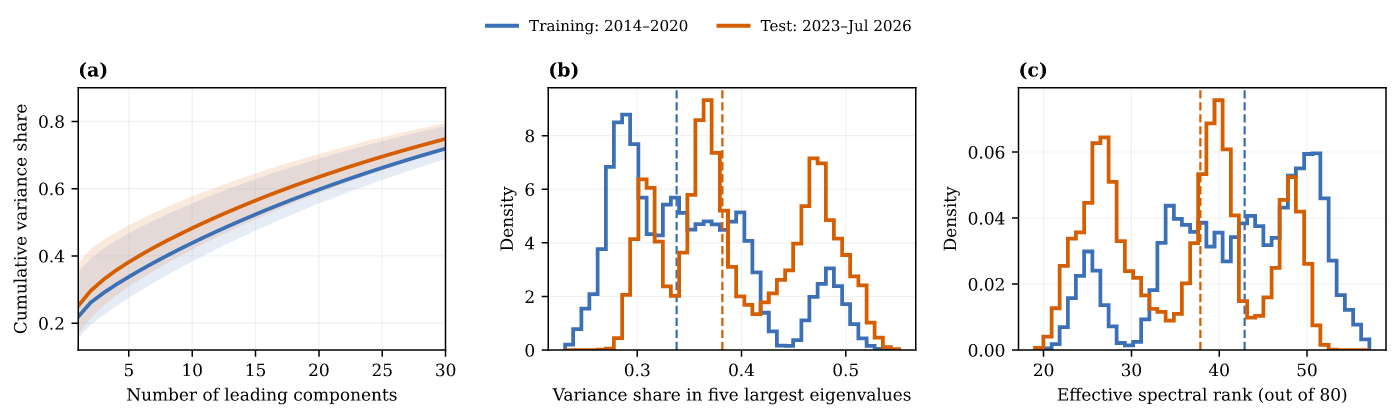
Correlation matrices combine nonlinear positive-definiteness constraints with a simultaneous row-column permutation symmetry. Their generation therefore involves two distinct problems. First, every output must remain on the correlation elliptope, irrespective of how its variables are ordered. Second, the generator must learn the domain-specific distribution occupied by empirical data inside that valid space. Existing financial image generators mix these problems: they learn ordered matrix entries and repair invalid draws afterward. We introduce CorrFlow, which separates them. A generalized Fisher transform maps full-rank correlation matrices bijectively to unconstrained coordinates, guaranteeing valid outputs without projection. A graph flow-matching network learns the empirical distribution in those coordinates and is permutation equivariant: reordering the variables only reorders the output. We compare a conditional CorrGAN reimplementation, image diffusion, and CorrFlow on $80\times80$ Taiwan equity matrices using five seeds per neural method. CorrFlow produces 100% valid draws without repair and obtains feature sliced-Wasserstein distance $.712\pm.141$, versus $4.339\pm.252$ for CorrGAN and $4.610\pm.191$ for image diffusion after their invalid outputs are projected back to the correlation space. It also improves this distance over historical lookup, while lookup retains higher local coverage. These results support the combined construction under the evaluated training budget; they do not establish superiority over fully tuned image models or isolate the contribution of each component.
Citations and venue from Semantic Scholar (ODC-BY), refreshed weekly. Summary: Quant Letter (CC BY 4.0).