arXivEconometrics & Forecasting
Realized Tail-Risk Conditional Autoregressive Expectile Models: Accurate and Stable Forecasting Performance
A realized tail-risk model using high-frequency intraday data forecasts value-at-risk and expected shortfall with competitive performance across U.S. stock returns and multiple tail levels.
Featured in No. 135 on 16 Oct 2026 · 4 days after release
- Released
- 12 Oct 2026
- First featured
- No. 135 · 16 Oct 2026
- Published in
- Not yet, as far as Semantic Scholar knows
- Fanfare
- 2 of 5
- Identifier
- arXiv:2610.13446
- Authors
- Keisuke Sasaki and Yasuhiro Omori
Abstract
From arXiv (CC0).
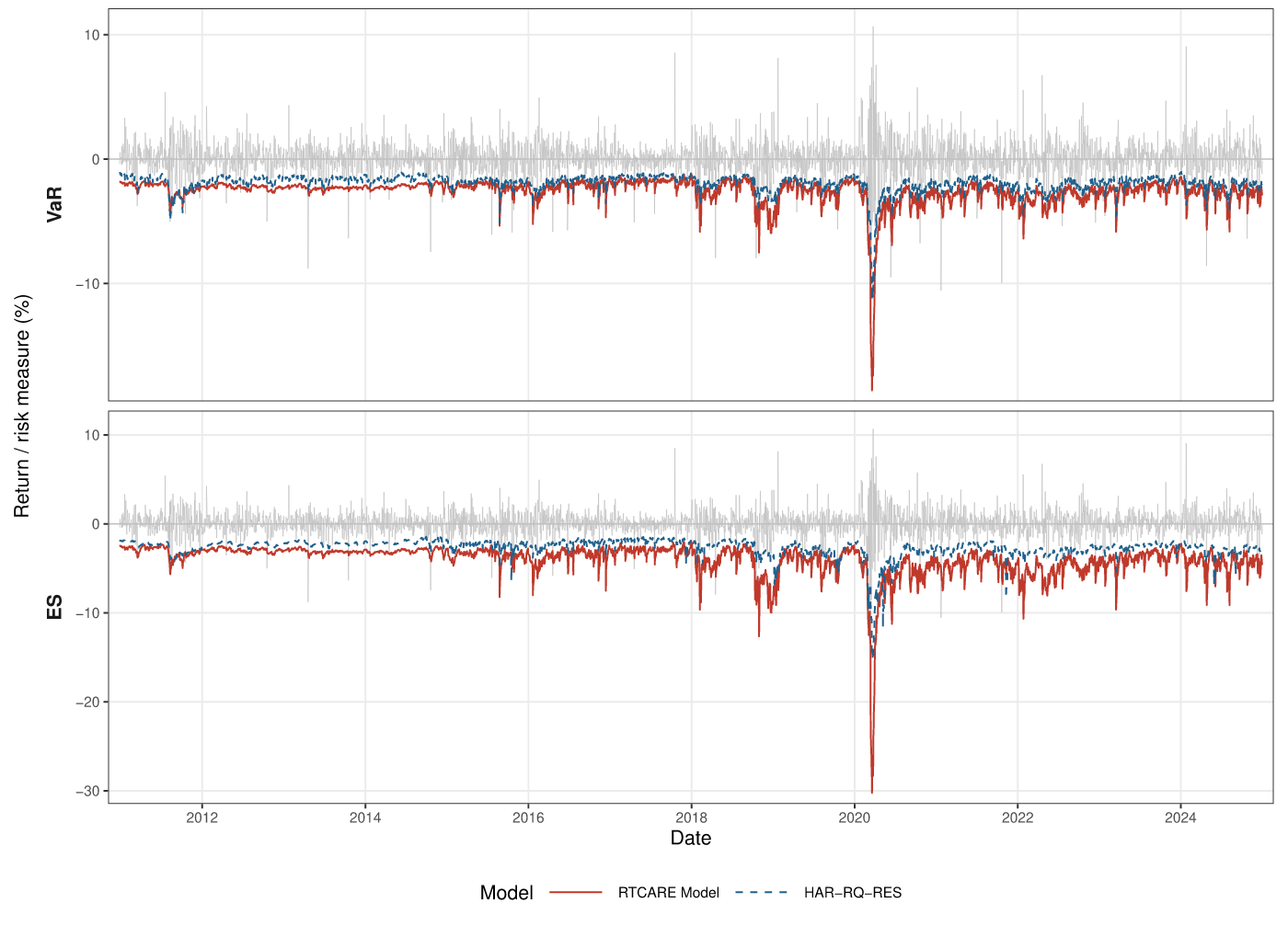
A realized tail-risk conditional autoregressive expectile (RTCARE) model is proposed for joint forecasting of value-at-risk (VaR) and expected shortfall (ES). Realized tail measures such as the realized quantile and the realized ES, constructed from intraday high-frequency returns, are incorporated into the dynamics and measurement equations of the conditional expectile, allowing information about lower-tail risk to enter the forecasts. The parameters are estimated by Markov chain Monte Carlo, and we evaluate the resulting VaR-ES forecasts in numerical examples and in an empirical application using U.S. stock-return data. Across the considered tail levels, the RTCARE models deliver competitive and often superior forecasting performance relative to existing alternatives, with stable results across Monte Carlo replications and rolling forecast evaluations.
Citations and venue from Semantic Scholar (ODC-BY), refreshed weekly. Summary: Quant Letter (CC BY 4.0).