arXivTrading, Microstructure & Execution
Market Impact Estimation via Causal Foundation Models
A causal prior-data fitted network trained on synthetic market priors estimates true market impact by isolating price movement from trading flow versus information, addressing bias in classical models.
Featured in No. 135 on 16 Oct 2026 · 4 days after release
- Released
- 12 Oct 2026
- First featured
- No. 135 · 16 Oct 2026
- Published in
- Not yet, as far as Semantic Scholar knows
- Fanfare
- 3 of 5
- Identifier
- arXiv:2610.12537
- Authors
- Dennis Thumm and Ying Chen
Abstract
From arXiv (CC0).
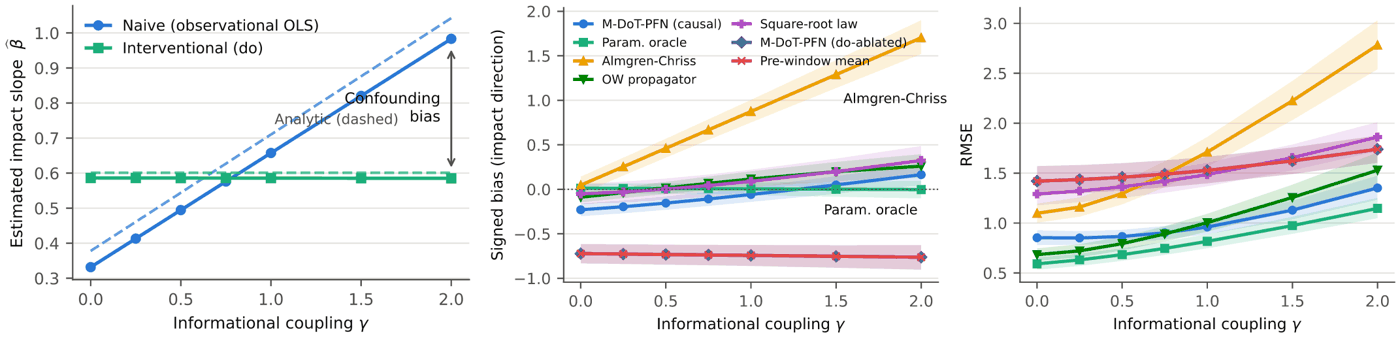
When a trader executes a large order, the relevant question is not \emph{what will the price be?} but \emph{what would the price have been had I not traded?} Market impact is thus a causal quantity, yet classical models (Almgren--Chriss, propagators) regress price on flow, which is biased whenever informed flow moves prices through information as well as trading. We present a proof-of-concept \emph{Causal Market Simulator}: a continuous-time causal prior-data fitted network (PFN) trained on a synthetic market prior in which a hidden informational flow confounds the flow--price relation by construction, with confounding strength an exact per-episode knob. On this prior, the naive estimator's bias follows a closed form we confirm empirically (up to 68\% overestimation), while the PFN tracks the unbiased true-parameter oracle at high confounding. Its \emph{do-ablated twin}, the same model with the intervention inputs removed, collapses onto the pre-window mean. Zero-shot, the model responds at the ground-truth scale to metaorders in an ABIDES limit-order book ($+0.38$ pre-onset standard deviations against seed-replay counterfactuals), and its intervention response replicates on about 2,300 detected flow bursts in BTC/ETH/SOL perpetuals and 3,800 on Nasdaq equities, evidence consistent with, though not proof of, causal transfer. Off-prior the response degrades gracefully, and split-conformal recalibration repairs interval calibration. Transfer hinges on encoding the metaorder as added flow rather than a clamped price level, not on more training. A recurrent state-space variant closes the remaining shape gap: its impact accrues over execution duration where the transformer's stays flat, raising the correlation with measured metaorder impact from $+0.68$ to between $+0.92$ and $+0.96$, at the cost of weaker on-prior deconfounding that traces to the training recipe rather than to recurrence.
Citations and venue from Semantic Scholar (ODC-BY), refreshed weekly. Summary: Quant Letter (CC BY 4.0).