Regime-Aware Estimation of Large Equity Correlation Matrices: Tail-Pairwise Dependence and Dynamic Conditional Correlation Decomposition for Water and Energy Sectors
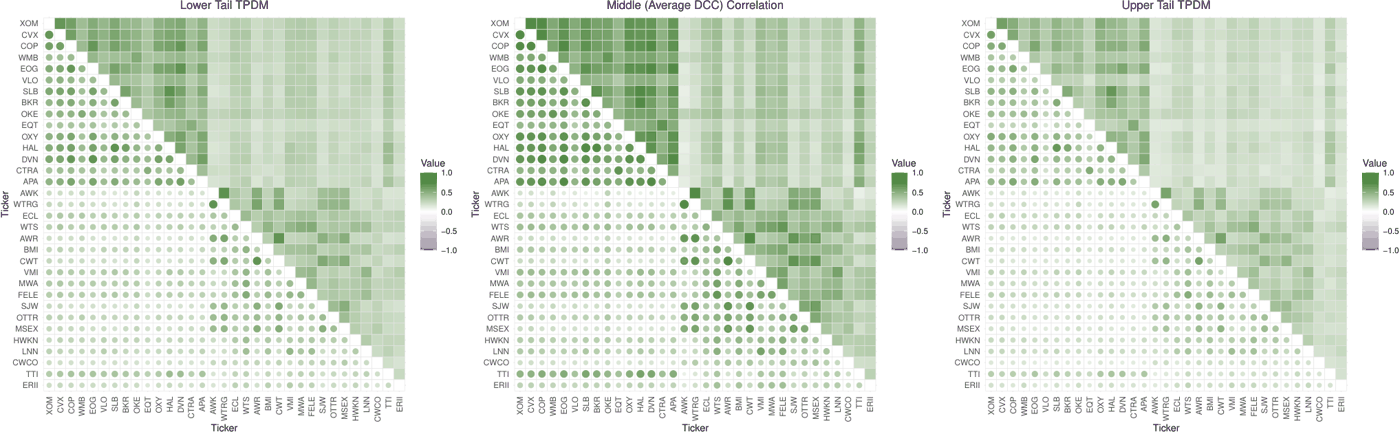
Fitting separate dependence matrices to lower-tail, central, and upper-tail regimes reveals tail-driven co-movements that single Gaussian-copula structures systematically miss.
Featured in No. 134 on 9 Oct 2026 · on release day
- Released
- 9 Oct 2026
- First featured
- No. 134 · 9 Oct 2026
- Published in
- Not yet, as far as Semantic Scholar knows
- Fanfare
- 2 of 5
- Identifier
- arXiv:2610.12166
- Authors
- Katherine B. Ensor et al.
Abstract
From arXiv (CC0).
Equity correlation matrices are foundational to quantitative risk, yet the operational default of a single Gaussian-copula structure fit to the full sample has a structural defect: it forces asymptotic tail-independence and so cannot represent the joint moves that drive risk in stress episodes. We argue that the dependence of equity returns is not one object but three distinct under lower-tail, central, and upper-tail conditions, and that any estimator aimed at tail-sensitive applications should be regime-aware. We develop a decomposition that fits a dedicated dependence matrix to each regime, using a tail-dependence estimator grounded in multivariate regular variation in the two tails and a time-varying conditional-correlation model in the central regime, and recombines the three at the unconditional regime probabilities to form a steady-state matrix. The construction identifies tail-regime dependence that the Gaussian-copula benchmark structurally suppresses. Demonstrated on water- and energy-sector Exchange Traded Funds (ETF) constituents, the tail regimes reorganize the commodity partition produced by the central regime, identifying the pairs where the Gaussian-copula default systematically fails to identify joint extreme co-movement.
Citations and venue from Semantic Scholar (ODC-BY), refreshed weekly. Summary: Quant Letter (CC BY 4.0).