MemTrial: Learning When to Trust Memory in LLM Portfolio Agents
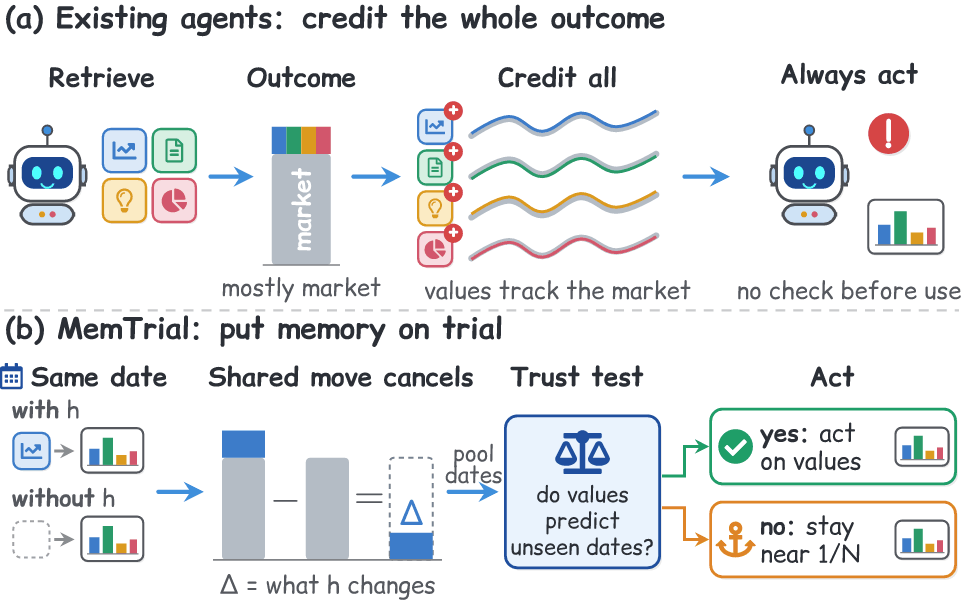
MemTrial uses factorial design to isolate what each memory contributes to portfolio decisions by crediting experiences with their marginal effect rather than shared market moves.
Featured in No. 134 on 9 Oct 2026 · on release day
- Released
- 9 Oct 2026
- First featured
- No. 134 · 9 Oct 2026
- Published in
- Not yet, as far as Semantic Scholar knows
- Fanfare
- 3 of 5
- Identifier
- arXiv:2610.11732
- Authors
- Guanghao Wu et al.
Abstract
From arXiv (CC0).
Large language model (LLM) agents for portfolio management learn from experience: they credit each experience in their memory with the outcome of the decisions that used it. In financial markets, however, this outcome mostly reflects the market move shared by all decisions on that date, so the credit tracks the market rather than the experience, and these agents often do worse than simply holding the equal-weight (1/$N$) portfolio. We ask how an agent can credit an experience with what it changes, and answer it by putting memory on trial: drafts of the same decision with and without an experience face the same market, so the outcome they share cancels in their difference. Our agent, MemTrial, drafts each decision with eight combinations of its retrieved experiences, chosen by a fractional factorial design, and credits each experience with its Banzhaf value, the average of these differences. As each date occurs once and each draft is a noisy LLM sample, these credits are noisy and may not hold on new dates. MemTrial therefore pools them across dates and similar experiences with a hierarchical Bayesian model, acts on them only after they have predicted unseen dates, and otherwise stays anchored at a conservative reference such as 1/$N$. On four benchmarks, MemTrial not only benefits from experiences that matter (the best of 15 methods on a semi-synthetic benchmark with known experience quality) but also limits its losses when its values do not hold (at most 2.2\% below 1/$N$ on PortBench and InvestorBench, against 15--38\% for the best experience-learning agent). Averaged over five settings, it improves the utility of the best experience-learning agent by 21.2\%, and with eight LLMs it beats every LLM-based baseline on InvestorBench.
Citations and venue from Semantic Scholar (ODC-BY), refreshed weekly. Summary: Quant Letter (CC BY 4.0).