Ranking Prior Alignment for Credit Risk Modeling: When Do External Priors Matter?
A model-agnostic framework distills ranking priors from experts or teacher models into credit scorers via KL divergence, improving cold-start performance with scarce labeled data.
Featured in No. 134 on 9 Oct 2026 · on release day
- Released
- 9 Oct 2026
- First featured
- No. 134 · 9 Oct 2026
- Published in
- Not yet, as far as Semantic Scholar knows
- Fanfare
- 3 of 5
- Identifier
- arXiv:2610.11146
- Authors
- Qiye Lu et al.
Abstract
From arXiv (CC0).
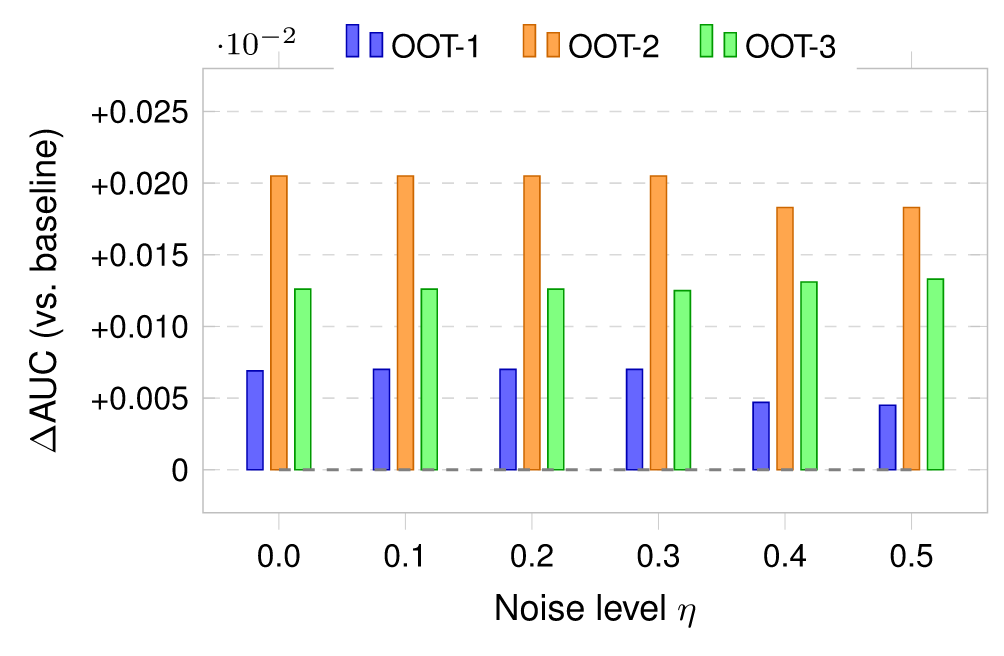
Cold-start credit scoring -- deploying models with scarce labeled data, weak features, or minimal capacity -- is a recurring problem in financial machine learning. When a new lending product launches, labeled default data is scarce, feature pipelines are immature, and models must be deployed with minimal capacity to avoid overfitting. Standard defenses operate on the same limited data; what is needed is a source of external regularization grounded in domain knowledge. We propose Ranking Prior Alignment, a model-agnostic framework that distills external ranking priors (from domain experts, teacher models, or LLMs) into any scoring model via a temperature-scaled KL divergence loss. The framework unifies neural (MIL attention) and tree-based (XGBoost custom objective) architectures through a single formulation: L = L_task + gamma(t) * KL(P_agent || P_model), where gamma(t) follows an exponential decay schedule. The method requires no external model at inference, and its tree-based instantiation tolerates annotation noise up to eta = 0.5. On an industrial dataset of over 1.5M merchants, MIL alignment achieves 7/7 positive evaluation cells at 3K bags (1 ID + 3 OOT + 3 degradation metrics; peak Delta AUC = +0.020 on OOT-1), and XGBoost ablation achieves 9/9 positive metrics at 300 bags. Cross-dataset validation on public Amex shows 5/5 positive folds (avg Delta AUC = +0.041). Four model families (MIL, XGBoost, LightGBM, Logistic Regression) and four teacher architectures show that the framework is both model-agnostic and prior-source-independent. We further observe that alignment gains exhibit an inverse-scaling pattern: benefits grow as data abundance N, model capacity C, and feature quality Q decrease, helping practitioners decide when to invest in prior annotation.
Citations and venue from Semantic Scholar (ODC-BY), refreshed weekly. Summary: Quant Letter (CC BY 4.0).