On the Boundary of Admission Gates: An Injected-Truth Study of Falsification-First Selection in Quantitative Strategy Research
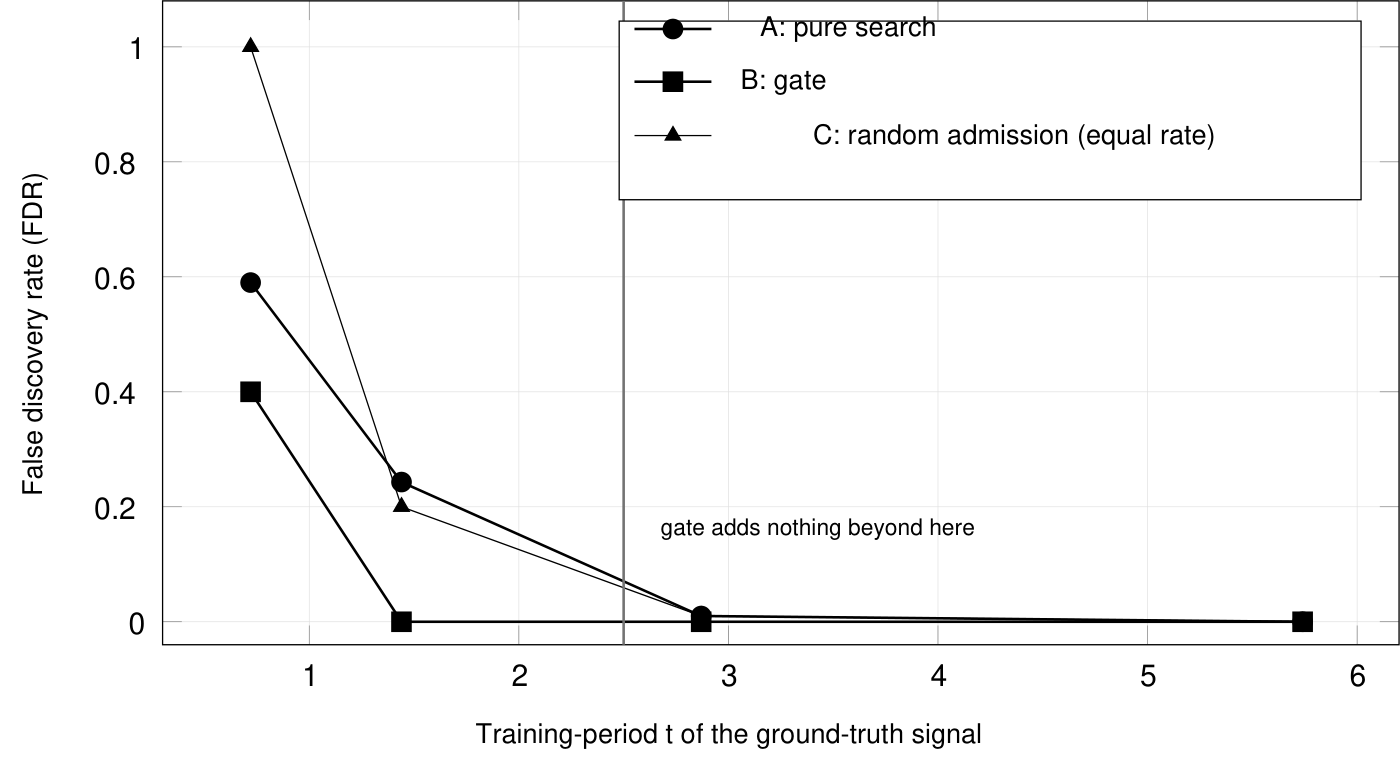
An injected-truth protocol reveals that statistical admission gates eliminate false discoveries in weak-signal regimes but cut adoption rates to 1–7 percent, while criteria computed on absolute rather than excess returns reject all candidates.
Featured in No. 134 on 9 Oct 2026 · 2 days after release
- Released
- 7 Oct 2026
- First featured
- No. 134 · 9 Oct 2026
- Published in
- Not yet, as far as Semantic Scholar knows
- Fanfare
- 3 of 5
- Identifier
- arXiv:2610.07701
- Authors
- Tianlun Zheng
Abstract
From arXiv (CC0).
Strategy research conflates two problems: finding a profitable rule, and establishing that the finding is not search luck. The latter calls for admission gates -- statistical criteria that must be satisfied before a conclusion is adopted -- yet whether gates work, and at what cost, remains untested. We introduce an injected-truth protocol with a random-admission control that adopts at the same rate as the gate; only if the gate beats this control does it carry information rather than merely raise a threshold. Across synthetic and real-calibrated panels, gates eliminate false discoveries in the weak-signal regime but cut adoption to 1--7%, and add nothing when signals are strong. Most importantly, criteria computed on absolute rather than excess returns silently reject every candidate, including true signals. Keywords: multiple testing, backtest overfitting, strategy admission, injected-truth validation, excess returns, false discovery rate
Citations and venue from Semantic Scholar (ODC-BY), refreshed weekly. Summary: Quant Letter (CC BY 4.0).