Robust enhanced index tracking portfolio selection under distributional uncertainty
Robust optimization models minimize worst-case loss and downside risk for enhanced indexing under distributional uncertainty, beating benchmarks and standard robust approaches in out-of-sample wealth.
Featured in No. 134 on 9 Oct 2026 · 3 days after release
- Released
- 6 Oct 2026
- First featured
- No. 134 · 9 Oct 2026
- Published in
- Not yet, as far as Semantic Scholar knows
- Fanfare
- 2 of 5
- Identifier
- arXiv:2610.04221
- Authors
- Jun Cai and Zhiqiao Song
Abstract
From arXiv (CC0).
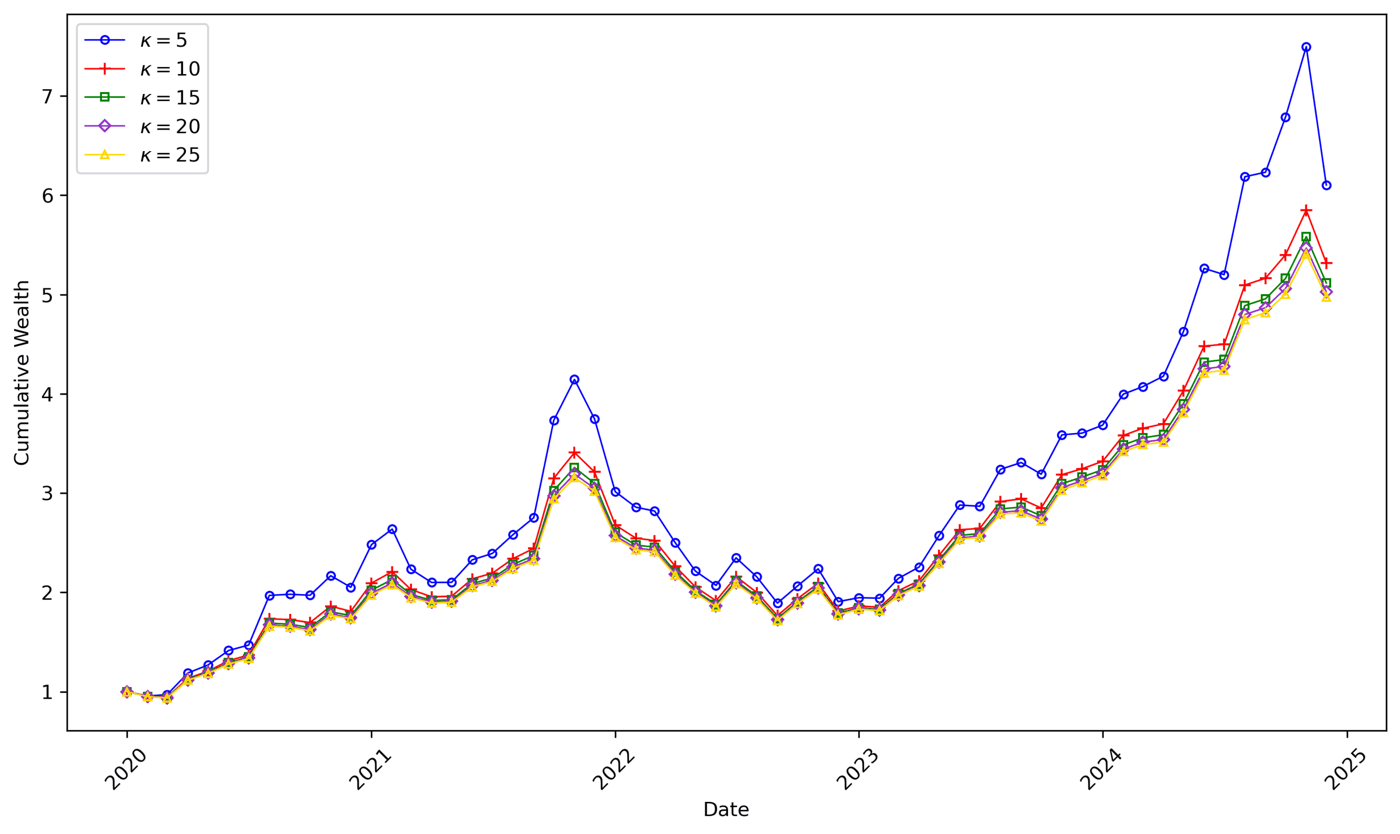
The enhanced index tracking (EIT) portfolio selection problem aims to construct a portfolio that is expected to outperform a benchmark index. In practice, investors face uncertainty in the joint distribution of asset and index losses, as the true distribution is typically unknown and only partial information is available. Moreover, portfolio selection requires balancing the trade-off between mean loss and downside risk while targeting higher returns. Effectively modeling and managing these factors in EIT portfolio selection is therefore of both practical and research interest. To address these challenges, this paper proposes robust EIT portfolio selection models under distributional uncertainty, guided by Pareto-optimality theory. The models minimize a convex combination of worst-case mean loss and downside risk, subject to a constraint on worst-case mean return. Two uncertainty sets are considered: one assuming a known mean loss vector and covariance matrix, and a more general set with unknown moments. Closed-form solutions are derived for the former, while the latter reduces to tractable convex optimization problems. Empirical results based on real market data show that the proposed models outperform not only the tracked index but also the equally weighted portfolio, robust mean-variance models, and robust variance models in terms of out-of-sample cumulative wealth, as well as Sharpe, Sortino, and Omega ratios. Moreover, portfolios that minimize a convex combination of worst-case mean loss and downside risk consistently outperform those that minimize downside risk alone. We also provide practical guidance for selecting optimal weighting coefficients to effectively balance risk and return.
Citations and venue from Semantic Scholar (ODC-BY), refreshed weekly. Summary: Quant Letter (CC BY 4.0).