arXivTrading, Microstructure & Execution
Certified Alpha Capacity: Statistical Evidence, Economic Lifetime, and Arbitrage under Decay
The research measures when a trading signal accumulates enough statistical evidence for deployment before its economic value decays, deriving exact feasibility thresholds.
Featured in No. 133 on 2 Oct 2026 · on release day
- Released
- 2 Oct 2026
- First featured
- No. 133 · 2 Oct 2026
- Published in
- Not yet, as far as Semantic Scholar knows
- Fanfare
- 4 of 5
- Identifier
- arXiv:2610.01115
- Authors
- Nicolò Bonacorsi
Abstract
From arXiv (CC0).
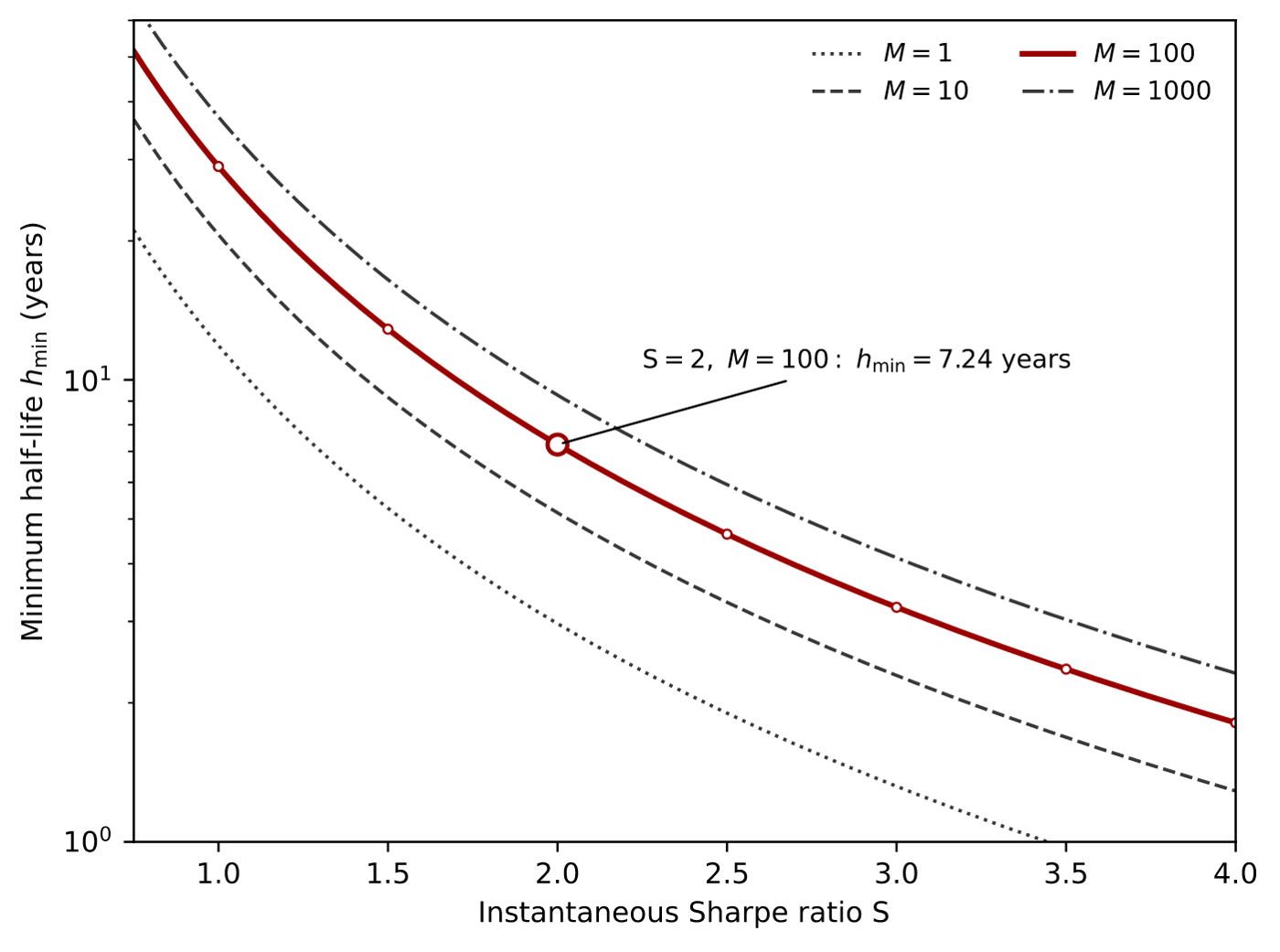
In this paper we study whether a trading signal can accumulate enough statistical evidence for reliable deployment before its economic value decays. We solve the problem by measuring statistical evidence and remaining opportunity on a common Kullback-Leibler information scale, obtaining an exact feasibility threshold in a canonical Gaussian model and general information lower bounds beyond it. We show that finite information budgets generate survival frontiers, search penalties, and a market equilibrium in which arbitrage activity shortens the lifetime of certifiable opportunities; a retrospective funding-rate study illustrates the role of persistence.
Citations and venue from Semantic Scholar (ODC-BY), refreshed weekly. Summary: Quant Letter (CC BY 4.0).