Admissible Portfolio Optimization: Information Constraints, Conditional Efficient Frontiers, and the Price of Causal Identification
The research makes conditioning information a decision variable subject to constraints, solving how look-ahead bias and information availability affect portfolio choice and causal identification.
Featured in No. 133 on 2 Oct 2026 · on release day
- Released
- 2 Oct 2026
- First featured
- No. 133 · 2 Oct 2026
- Published in
- Not yet, as far as Semantic Scholar knows
- Fanfare
- 3 of 5
- Identifier
- arXiv:2610.00147
- Authors
- Alejandro Rodriguez Dominguez
Abstract
From arXiv (CC0).
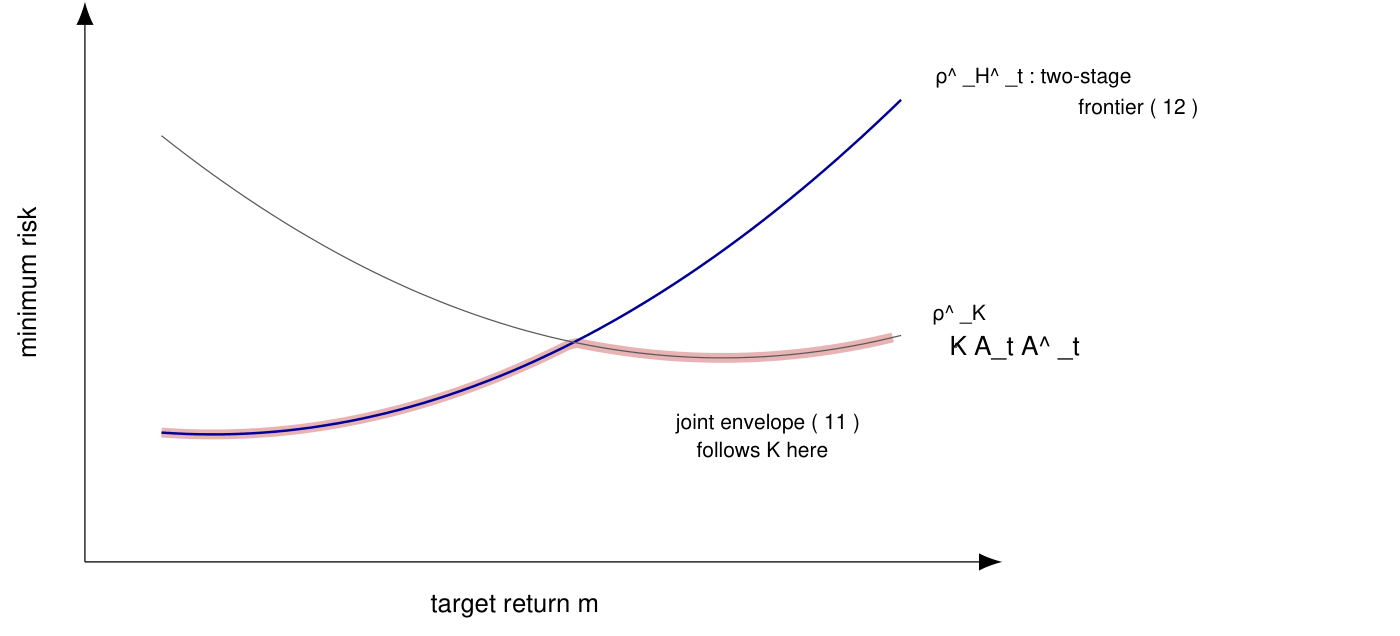
Mean--variance portfolio choice takes the conditioning information as given and optimizes over weights, so two errors about that information pass into the portfolio unseen: using variables unavailable at the decision time and treating common variation as idiosyncratic. We make the conditioning information a decision variable subject to hard admissibility constraints declared in advance: availability, a no-arbitrage-preserving enlargement of the decision filtration, statistical separation and, for interventional claims, invariance across declared regimes. A lexicographic admissibility order in which no risk--return quantity enters selects an optimal information class, and the classical problem is solved inside it. We prove existence, invariance under recodings, and a value-of-admissible-information theorem whose failure conditions show that selection by decision loss admits look-ahead information whenever present; the two-stage solution and the joint envelope are the minimal elements of two orders on one set. Under exact separation the diversifiable part of risk is a property of the admissible class and is interventionally stable only under interventional admissibility; requiring causal identification carries an explicit oracle price traded against search complexity. The estimator is consistent with second-order regret. On market data with 127 candidate drivers the condition is attainable on individual equities, where enlarging the search reduces the defect at a measurable rate, and not on pre-diversified portfolios, where it is nearly invariant to the search because the residual dependence is the common factor itself. Where it fails, the covariance still yields minimum-variance portfolios that match shrinkage at markedly lower turnover while discarding a measurable part of their risk, which an exact decomposition attributes to the residual share, breadth and average residual correlation.
Citations and venue from Semantic Scholar (ODC-BY), refreshed weekly. Summary: Quant Letter (CC BY 4.0).