arXivTrading, Microstructure & Execution
Say, Echo, Do: Strategic Narratives and Revealed Positioning in Financial Markets
The research shows when to follow or fade financial narratives by studying the covariance between institutional statements and revealed trading positions using machine learning.
Featured in No. 133 on 2 Oct 2026 · 1 day after release
- Released
- 1 Oct 2026
- First featured
- No. 133 · 2 Oct 2026
- Published in
- Not yet, as far as Semantic Scholar knows
- Fanfare
- 3 of 5
- Identifier
- arXiv:2609.38545
- Authors
- Ali Atiah Alzahrani
Abstract
From arXiv (CC0).
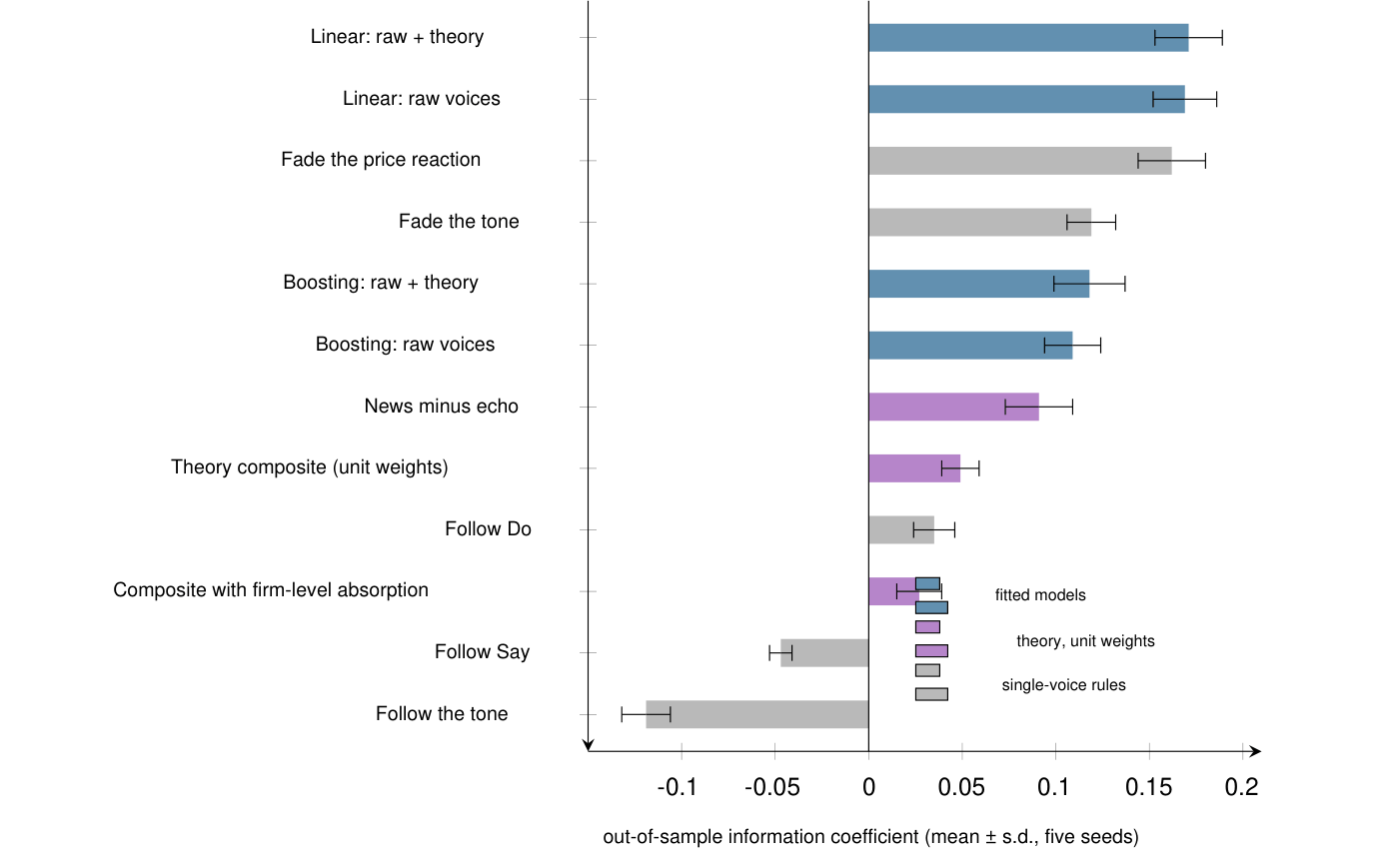
Machine-learning signals built from financial text treat what institutions say, and what the media repeat, as evidence about value. But whoever shapes a narrative may be trading against it. We study markets with three observable voices: institutional statements (Say), media repetition (Echo) and revealed positioning (Do). We ask when words should be followed and when they should be faded. In a linear-quadratic model of an informed institution that speaks and trades before a partly credulous crowd, talking an asset down while buying it is optimal exactly when $\varphi^2<2λk<\varphi$. A distribution-free identity then shows that when the observable Say-Do covariance is negative, words carry negative predictive content and should be faded. For measurement, we derive (i) an exact factorised posterior over which articles are echoes, combining arrival times with embedding similarity; (ii) a return-aligned contrastive objective that attains its bound exactly when squared embedding distances are an increasing affine function of squared outcome distances, with the tightest loss-based certificate of which neighbour rankings survive imperfect training; and (iii) a path-signature statistic for who moved first. In a controlled market with known ground truth, echo sentiment predicts returns with a significantly negative sign in all 29 simulated markets, the rolling Say-Do correlation flags false-alarm events with an AUC of 0.90, and return-aligned embeddings organise headlines by consequence rather than topic. We also report where the tools fail.
Citations and venue from Semantic Scholar (ODC-BY), refreshed weekly. Summary: Quant Letter (CC BY 4.0).