When Stress Tests Miss the Risk: Statistical Scenario Analysis for Financial Portfolios
Kernel scenario analysis estimates quantile predictions for portfolio stress-test gains, with online calibration to capture dependence between stressed and unstressed risk factors.
Featured in No. 133 on 2 Oct 2026 · 2 days after release
- Released
- 30 Sep 2026
- First featured
- No. 133 · 2 Oct 2026
- Published in
- Not yet, as far as Semantic Scholar knows
- Fanfare
- 2 of 5
- Identifier
- arXiv:2609.37273
- Authors
- Zhongze Cai et al.
Abstract
From arXiv (CC0).
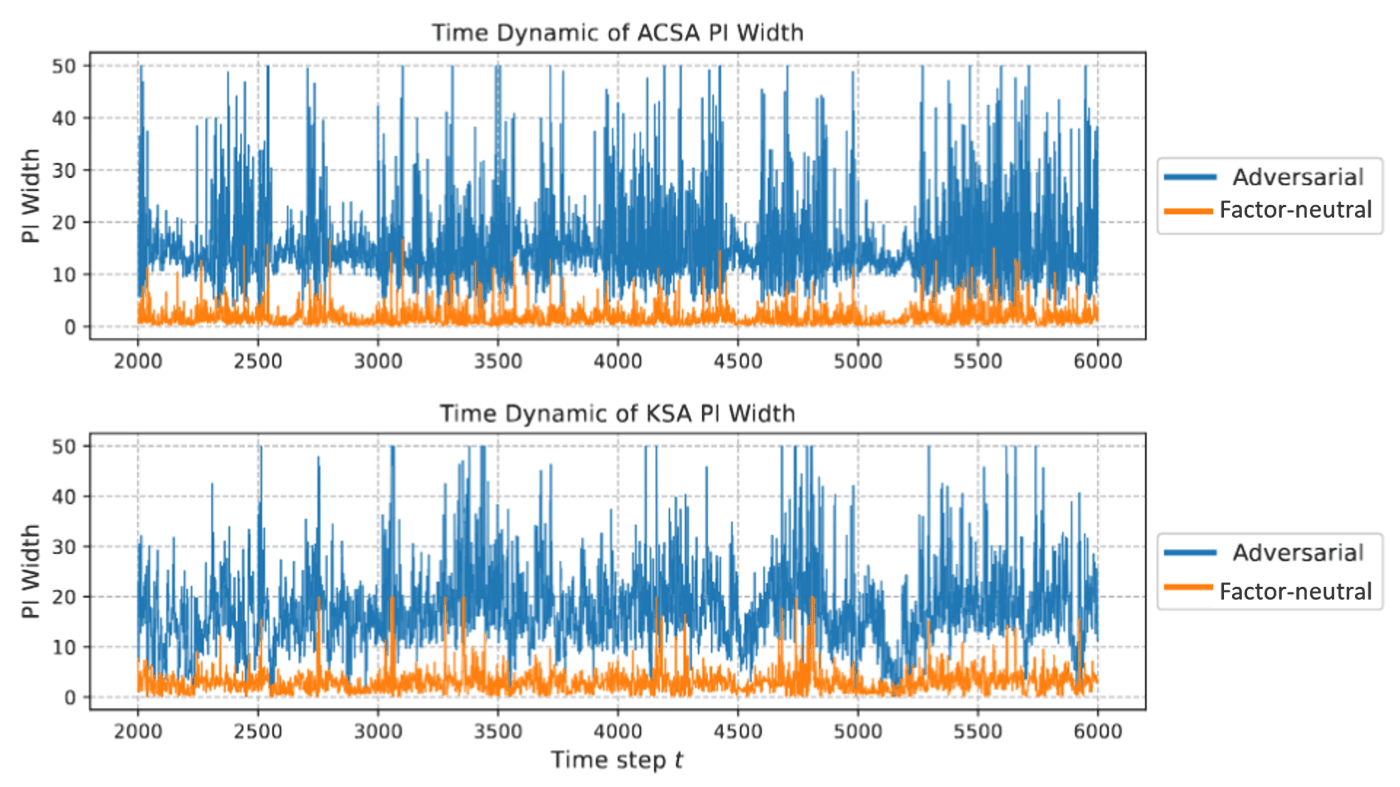
Scenario analysis is widely used to stress test financial portfolios, yet conventional approaches often summarize scenario gains using point estimates that overlook dependence between stressed and unstressed risk factors. We develop a machine learning framework for quantifying uncertainty in realized next-day scenario gains through prediction intervals whose widths can be calibrated online. Adaptive conformal scenario analysis (ACSA) calibrates scenario-specific quantile predictions and provides a long-run empirical coverage guarantee over realized scenarios. Our main method, kernel scenario analysis (KSA), estimates scenario-conditional quantiles directly from the specified stress and current market information. KSA can also be combined with ACSA to obtain online-calibrated prediction intervals. In experiments designed to reflect real-world markets, conventional scenario analysis can substantially understate risk, including for portfolios that appear safe under standard stress tests. Our proposed methods achieve better calibration and sharper intervals than empirical-quantile baselines. Overall, the framework moves scenario analysis beyond point estimates by quantifying predictive uncertainty and providing tools for statistically validating scenario gains.
Citations and venue from Semantic Scholar (ODC-BY), refreshed weekly. Summary: Quant Letter (CC BY 4.0).