arXivML & AI Methods
Deep kernel hedging
A hybrid approach combining neural networks with kernel methods produces robust derivative hedges in low-data regimes and scales via random Fourier features with convergence guarantees.
Featured in No. 133 on 2 Oct 2026 · 3 days after release
- Released
- 29 Sep 2026
- First featured
- No. 133 · 2 Oct 2026
- Published in
- Not yet, as far as Semantic Scholar knows
- Fanfare
- 2 of 5
- Identifier
- arXiv:2609.34474
- Authors
- Jean-Loup Dupret et al.
Abstract
From arXiv (CC0).
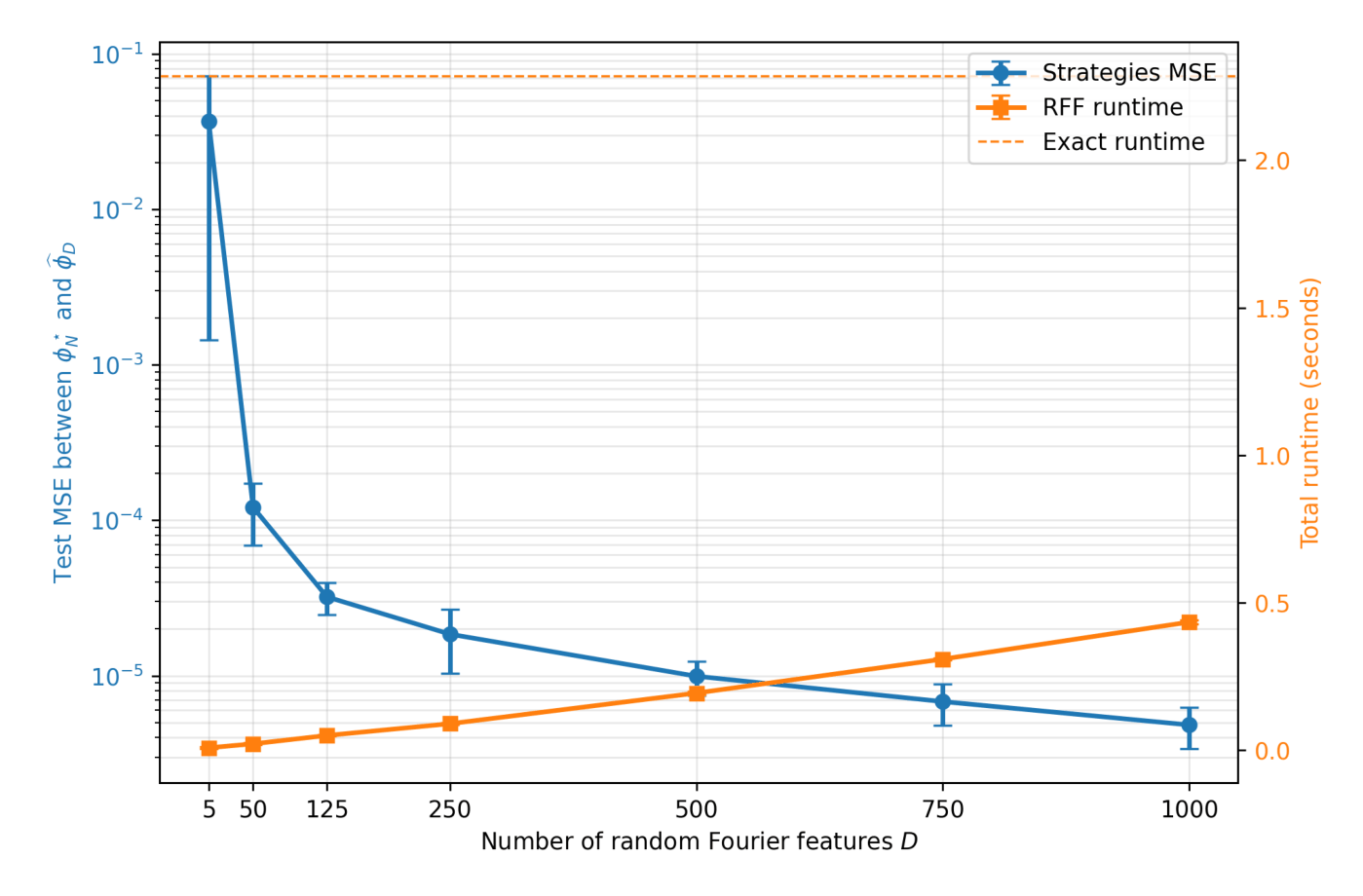
We introduce a deep kernel hedging framework that combines the flexibility of deep learning with the structural inductive bias of kernel methods. The hedging functional is restricted to a reproducing kernel Hilbert space whose kernel is parameterized through a neural network embedding of the input features. The framework minimizes a regularized empirical risk under convex loss functions and can accommodate path-dependent information through truncated time-augmented signature features. We derive a generalized representer theorem for the joint hedging problem, reducing the empirical optimization to a finite-dimensional problem. To further reduce the computational cost associated with large kernel matrices, we develop a scalable random Fourier feature approximation and establish convergence guarantees. The random Fourier parameters are sampled once and remain fixed throughout training, while the deep kernel adapts to market data through the learned neural representation. We evaluate the performance of the proposed deep kernel approach on both synthetic and real data and compare it with standard kernel methods and classical deep hedging architectures. Numerical results indicate competitive and robust hedging performance, particularly in low-data regimes, which highlights the benefits of combining expressive neural representations with the inductive bias of kernel methods.
Citations and venue from Semantic Scholar (ODC-BY), refreshed weekly. Summary: Quant Letter (CC BY 4.0).