arXivML & AI Methods
Same Text, Different Numbers: The Divergence of LLM-Based Measures
Cross-model rank correlations for LLM-extracted sentiment, clarity and risk average only 0.52, and model choice significantly alters coefficient signs and significance in downstream analysis.
Featured in No. 133 on 2 Oct 2026 · 4 days after release
- Released
- 28 Sep 2026
- First featured
- No. 133 · 2 Oct 2026
- Published in
- Not yet, as far as Semantic Scholar knows
- Fanfare
- 3 of 5
- Identifier
- arXiv:2609.31013
- Authors
- Hamid Boustanifar and Sasan Mansouri
Abstract
From arXiv (CC0).
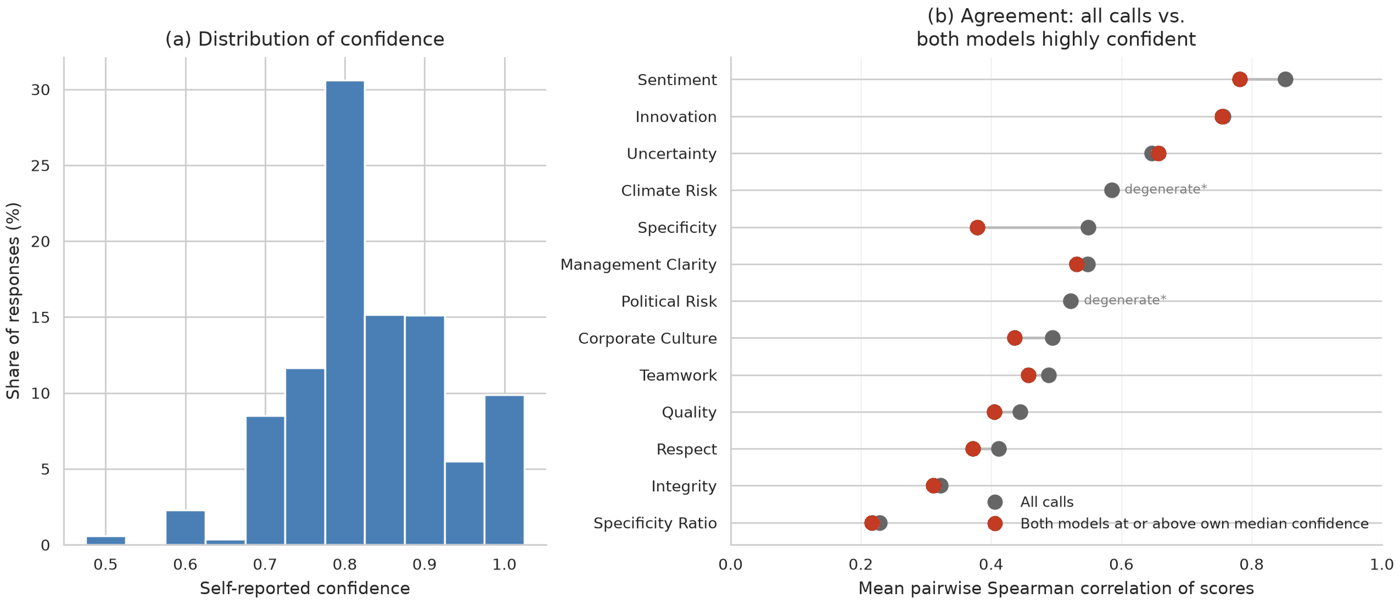
Researchers increasingly use generative large language models (LLMs) to convert corporate text into empirical variables. We examine the extent to which LLM-based textual measures are invariant to model choice using thirteen measures, including sentiment, management clarity, uncertainty, answer specificity, and climate and political risk. Seven LLMs from different providers score earnings call transcripts of S&P 500 companies on these constructs. Cross-model rank correlations average only 0.52, and transcript-level differences common across providers account for only 34% of total score variation. Cross-model disagreement does not predict subsequent analyst or market disagreement, consistent with a substantial model-specific component rather than common ambiguity in the underlying disclosure. Model choice significantly affects downstream inference, with coefficient magnitudes, signs, and statistical significance varying substantially across models. Averaging across providers makes transcript rankings more stable for most constructs, but score levels remain sensitive to the models included in the ensemble. LLM-generated variables should therefore be treated as model-contingent measurements and validated across providers.
Citations and venue from Semantic Scholar (ODC-BY), refreshed weekly. Summary: Quant Letter (CC BY 4.0).