arXivEconometrics & Forecasting
The Impossible Trinity of Time-Series Validation: A Conservation Law among Training Sufficiency, Test Coverage, and Temporal Causality
Proves that training sufficiency, test coverage, and temporal causality cannot be maximized simultaneously in time-series validation, pricing each constraint explicitly.
Featured in No. 132 on 25 Sep 2026 · on release day · 0 citations today
- Released
- 25 Sep 2026
- First featured
- No. 132 · 25 Sep 2026
- Citations (Semantic Scholar)
- 0
- Influential citations
- 0
- Published in
- Not yet, as far as Semantic Scholar knows
- Fanfare
- 4 of 5
- Identifier
- arXiv:2609.29530
- Authors
- Jiayu Li
Abstract
From arXiv (CC0).
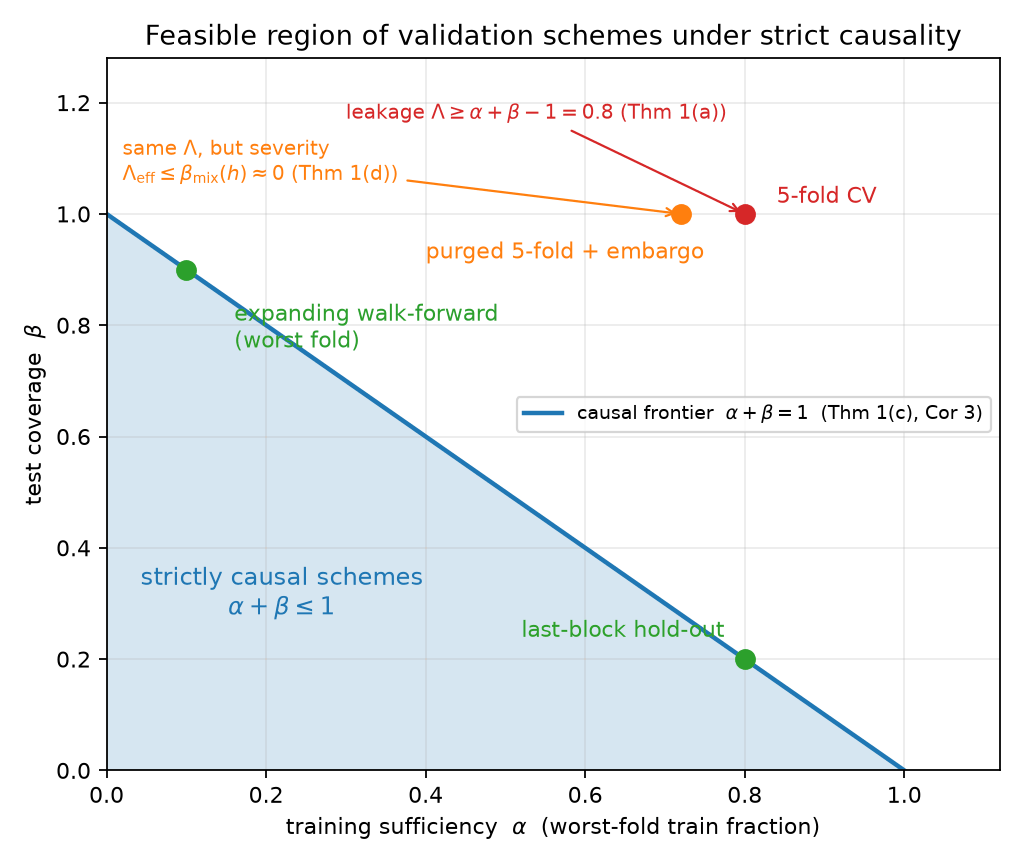
Validating a model on a time series asks for three things at once: each training run should use most of the sample (sufficiency), the test sets should together cover most of the sample (coverage), and training data should come before test data (causality). We prove that the three cannot be had together and price each one. Let $α$ be the smallest training fraction over folds, $β$ the fraction of the sample covered by tests, $Λ$ the fraction of the sample used as training data from the future of a test point, and $δ$ the distance from a test point to the nearest training point in its future. Every scheme on a sample of length $T$ satisfies $α+β\le 1+Λ$ and $α+\min\{β,δ/T\} \le 1$, and under $β$-mixing the leakage bias at a test point is at most $2Mβ_{\mathrm{mix}}(δ)$. In words: going beyond the causal frontier $α+β=1$ requires training on the future; that future data must sit within $(1-α)T$ of a test point; and its harm depends on its distance, not its amount. Hence expanding walk-forward is exactly the Pareto frontier of causal validation, $k$-fold cross-validation buys the most future data, and purged $k$-fold with an embargo pays in distance instead, which is cheap when the process forgets quickly but cannot repair the part of causality demanded by non-stationarity. On pure noise, shuffled 5-fold reports an information coefficient of $+0.32$, while contiguous 5-fold, using the same amount of future data, reports $+0.004$.
Citations and venue from Semantic Scholar (ODC-BY), refreshed weekly. Summary: Quant Letter (CC BY 4.0).