arXivTrading, Microstructure & Execution
Feasible Multi-Asset Optimal Execution under Cash Constraints
Extends the Almgren-Chriss optimal execution framework to enforce intertemporal cash constraints, reducing peak cash drawdown while maintaining implementation shortfall in multi-asset rebalancing.
Featured in No. 132 on 25 Sep 2026 · 1 day after release · 0 citations today
- Released
- 24 Sep 2026
- First featured
- No. 132 · 25 Sep 2026
- Citations (Semantic Scholar)
- 0
- Influential citations
- 0
- Published in
- Not yet, as far as Semantic Scholar knows
- Fanfare
- 2 of 5
- Identifier
- arXiv:2609.27786
- Authors
- Ryuji Hashimoto and Namid R. Stillman
Abstract
From arXiv (CC0).
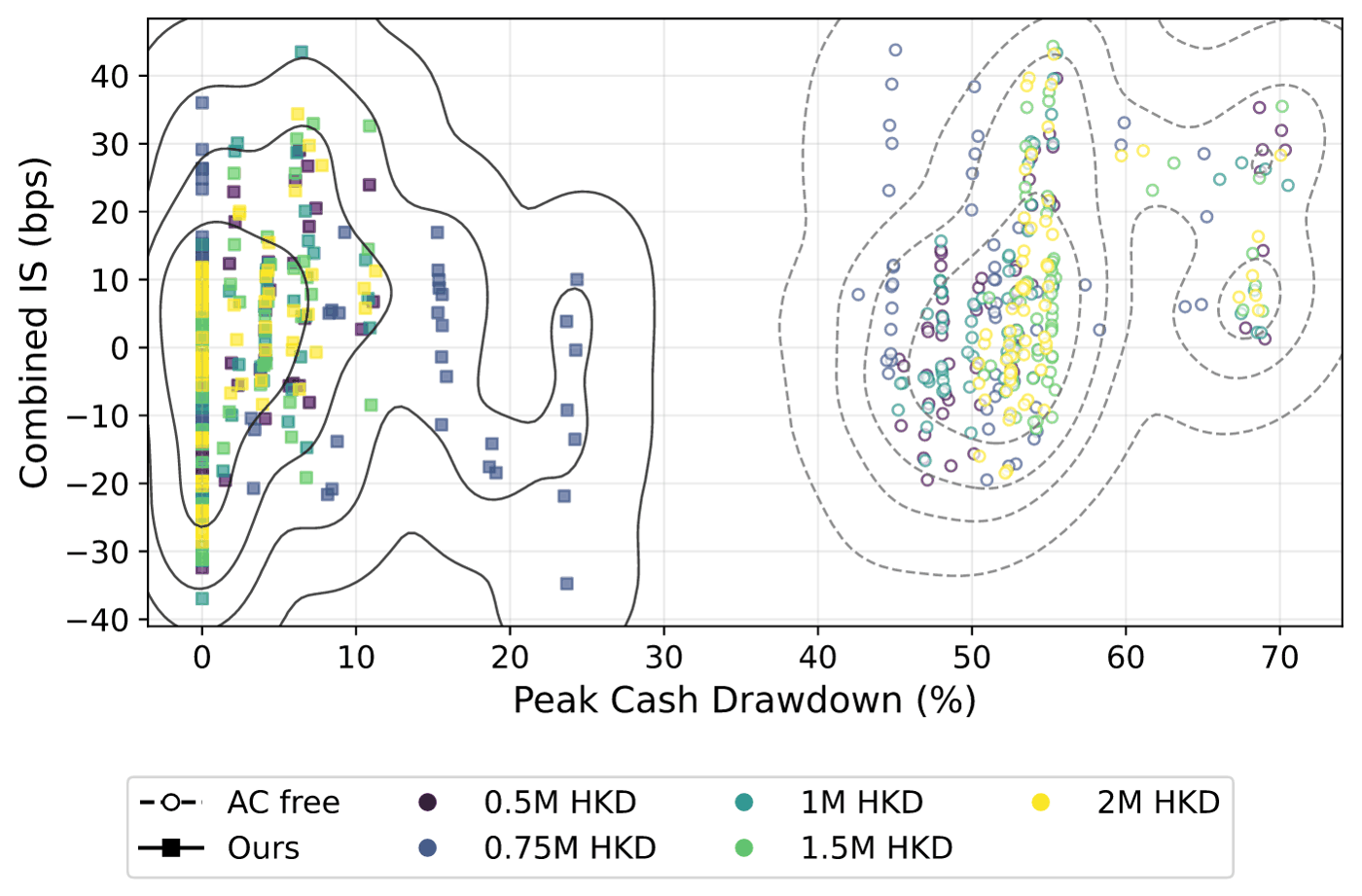
Optimal execution (OE) in multi-asset settings involves complex interactions across assets, particularly through shared capital constraints during portfolio rebalancing. While existing models capture cross-impact and portfolio-level dynamics, they largely overlook the role of explicit cash constraints along the execution trajectory. As a result, the feasibility of execution strategies under limited capital remains poorly understood. In this paper, we extend the classical Almgren-Chriss framework to incorporate intertemporal constraints on expected cash consumption, requiring that the expected cumulative cash spent does not exceed a prescribed budget at every trading period. We show that the resulting multi-asset OE problem can be equivalently formulated as a quadratically constrained quadratic program (QCQP), and further establish that it admits a convex representation under mild conditions. This provides a tractable framework for analyzing execution strategies under dynamic capital constraints. Through controlled synthetic experiments, we show that the proposed cash constraints qualitatively alter OE schedules toward cash-feasible sell-first executions as the constraints become tighter. Furthermore, evaluations in an out-of-sample agent-based market simulator demonstrate that our method substantially reduces peak cash drawdown while maintaining implementation shortfall comparable to existing execution strategies. Our results highlight the importance of explicitly modeling financial feasibility in multi-asset execution and provide a foundation for bridging theoretical OE models with practical capital constraints.
Citations and venue from Semantic Scholar (ODC-BY), refreshed weekly. Summary: Quant Letter (CC BY 4.0).