arXivEconometrics & Forecasting
Hierarchical Multi-Task Learning with Liquidity-Aware Signals for Stock Forecasting
A hierarchical multi-task framework jointly predicts price movement, volatility and volume using liquidity-aware signals, outperforming neural and tree-based baselines on Chinese equity indices.
Featured in No. 132 on 25 Sep 2026 · 2 days after release · 0 citations today
- Released
- 23 Sep 2026
- First featured
- No. 132 · 25 Sep 2026
- Citations (Semantic Scholar)
- 0
- Influential citations
- 0
- Published in
- Not yet, as far as Semantic Scholar knows
- Fanfare
- 3 of 5
- Identifier
- arXiv:2609.25617
- Authors
- Hengyi Yang et al.
Abstract
From arXiv (CC0).
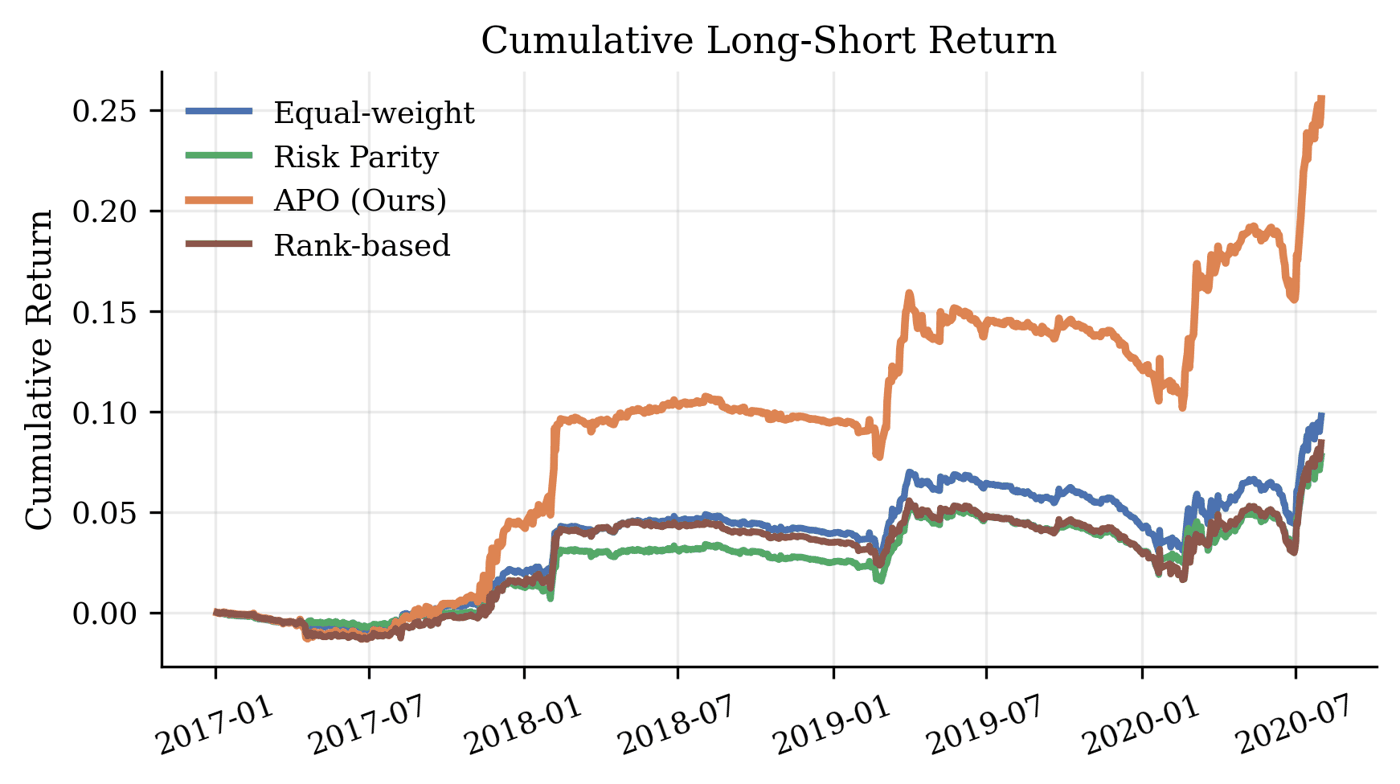
Stock price forecasting is a long-standing challenge in computational finance, driven by the inherent randomness of markets and complex temporal patterns. While recent deep-learning models have raised forecasting accuracy by jointly modeling inter-stock and temporal price dynamics, they conflate inter-stock relationships with intra-stock temporal dependencies and focus solely on the univariate objective of price movement. To address these limitations, we propose LiMT, a Hierarchical Multi-Task Learning framework that integrates liquidity-aware signals for stock price forecasting. LiMT employs a Market Regime Encoder (MRE) module that first extracts contemporaneous cross-stock dependencies, then models each stock's temporal dynamics, yielding a unified latent state. Building on this latent state, we introduce a Liquidity-Driven Learning (LDL) module, a mixture-of-experts architecture that features cross-task gating mechanisms to jointly predict price movement, volatility, and trading volume. We further design an Adaptive Portfolio Optimization (APO) mechanism that converts multi-task forecasts into executable portfolio weights under transaction-cost and liquidity constraints. Extensive experiments on the CSI300 and CSI500 benchmarks show that LiMT performs best among strong neural and tree-based baselines across the reported metrics. In realistic CSI300 backtests, APO improves annualized return from 3.99% to 10.01% and Sharpe ratio from 1.22 to 1.86 over equal weighting, showing that the multi-task forecasts translate into deployable portfolio gains.
Citations and venue from Semantic Scholar (ODC-BY), refreshed weekly. Summary: Quant Letter (CC BY 4.0).