DefaultGNN: A Dual-Perspective GNN Framework for Predicting Corporate Default from Buyer-Seller Transaction Networks
A dual-perspective graph neural network framework predicts corporate defaults from buyer-seller transaction networks, improving approval rates by 7-11 percentage points without increasing default risk.
Featured in No. 132 on 25 Sep 2026 · 2 days after release · 0 citations today
- Released
- 23 Sep 2026
- First featured
- No. 132 · 25 Sep 2026
- Citations (Semantic Scholar)
- 0
- Influential citations
- 0
- Published in
- Not yet, as far as Semantic Scholar knows
- Fanfare
- 3 of 5
- Identifier
- arXiv:2609.25542
- Authors
- Junghoon Kim et al.
Abstract
From arXiv (CC0).
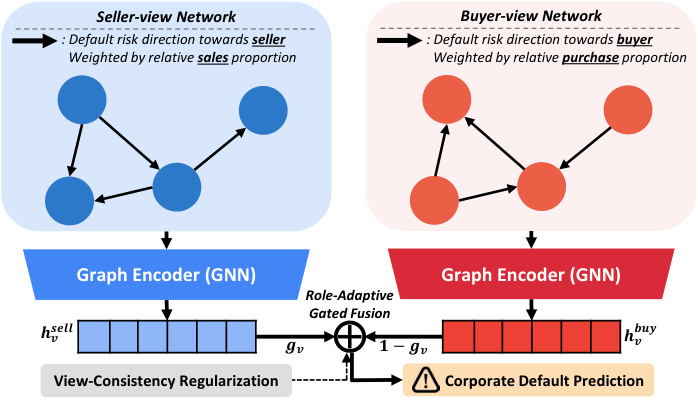
Corporate default prediction is a core problem in financial risk management, yet traditional credit models rely heavily on financial statements that are often sparse or unavailable for many firms. Corporate transaction networks offer a complementary view of real economic activity, but how risk propagates through buyer-seller relationships remains underexplored. We conduct a large-scale empirical study using real-world electronic tax-invoice data spanning six years that links transaction histories with default events, revealing that transaction-driven risk is both role-dependent (buyer or seller) and scale-dependent. Based on these findings, we construct multiplex buyer-view and seller-view transaction networks and propose DefaultGNN, a dual-perspective graph neural network-based framework for corporate default prediction. DefaultGNN integrates both views to model how risk flows through transactional relationships, achieving strong improvements over both attribute-based and graph-based baselines, especially for firms with limited intrinsic risk signals. We further provide interpretable network-based explanations by visualizing how distressed trading partners contribute to default risk. In collaboration with a licensed credit rating agency, we validate that DefaultGNN's predictions complement existing credit scoring models, improving approval rates by 7-11%p without increasing default risk among approved firms. The source code can be found at https://github.com/jhkim611/DefaultGNN
Citations and venue from Semantic Scholar (ODC-BY), refreshed weekly. Summary: Quant Letter (CC BY 4.0).