arXivLLMs & Text
FinInteract: Benchmarking Clarification and Intent Integration in Ambiguous Financial Question Answering
A benchmark reveals that language models answer financial questions above 90 percent with clarification but only 28.9 percent when they must elicit it themselves, exposing model ambiguity resolution.
Featured in No. 132 on 25 Sep 2026 · 3 days after release · 0 citations today
- Released
- 22 Sep 2026
- First featured
- No. 132 · 25 Sep 2026
- Citations (Semantic Scholar)
- 0
- Influential citations
- 0
- Published in
- Not yet, as far as Semantic Scholar knows
- Fanfare
- 3 of 5
- Identifier
- arXiv:2609.24002
- Authors
- Xinyu Wang et al.
Abstract
From arXiv (CC0).
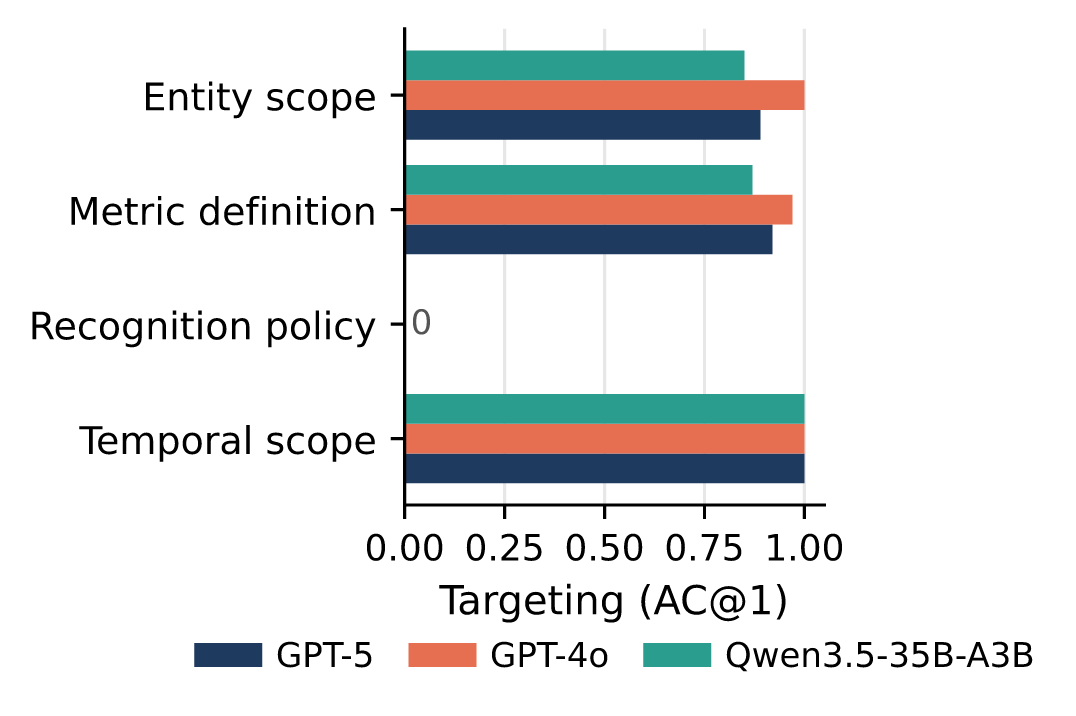
Large language model agents increasingly answer financial questions by searching regulatory filings. Such questions are often deceptively under-specified: Meta Platforms' "operating income" is $46.75B consolidated but $62.87B for the Family of Apps segment, and each reading is exactly verifiable against the filing. A capable agent should recognize the ambiguity and ask, rather than commit to a plausible but unintended reading. Existing financial benchmarks cannot measure this, because one gold answer per question cannot separate agents that resolve the ambiguity from those that guess the common reading, a blind spot we call the single-gold illusion. We release FinInteract, a bilingual (English/Chinese) benchmark of 173 instances that pairs each question with a default and an intended interpretation across a five-category ambiguity taxonomy, and grades whether an agent elicits the right clarification and then integrates it. Re-grading identical outputs against the default rather than the intended reading inflates GPT-4o's accuracy by 3.1 times, confirming the illusion. Beyond it, we find that models answer above 90% once the interpretation is supplied but at most 28.9% when they must elicit it themselves, that targeting is uneven across a taxonomy well powered for entity scope and metric definition and exploratory elsewhere, and that conditioning on the ambiguity category improves resolution at both inference and training time.
Citations and venue from Semantic Scholar (ODC-BY), refreshed weekly. Summary: Quant Letter (CC BY 4.0).