Risk Measures under Paired-Ambiguity: A Deep Learning Reflected BSDE Framework
Develops a deep learning scheme for optimal stopping under simultaneous model and discount-rate ambiguity, with application to American option valuation under uncertainty.
Featured in No. 132 on 25 Sep 2026 · 3 days after release · 0 citations today
- Released
- 22 Sep 2026
- First featured
- No. 132 · 25 Sep 2026
- Citations (Semantic Scholar)
- 0
- Influential citations
- 0
- Published in
- Not yet, as far as Semantic Scholar knows
- Fanfare
- 2 of 5
- Identifier
- arXiv:2609.23768
- Authors
- Nacira Agram et al.
Abstract
From arXiv (CC0).
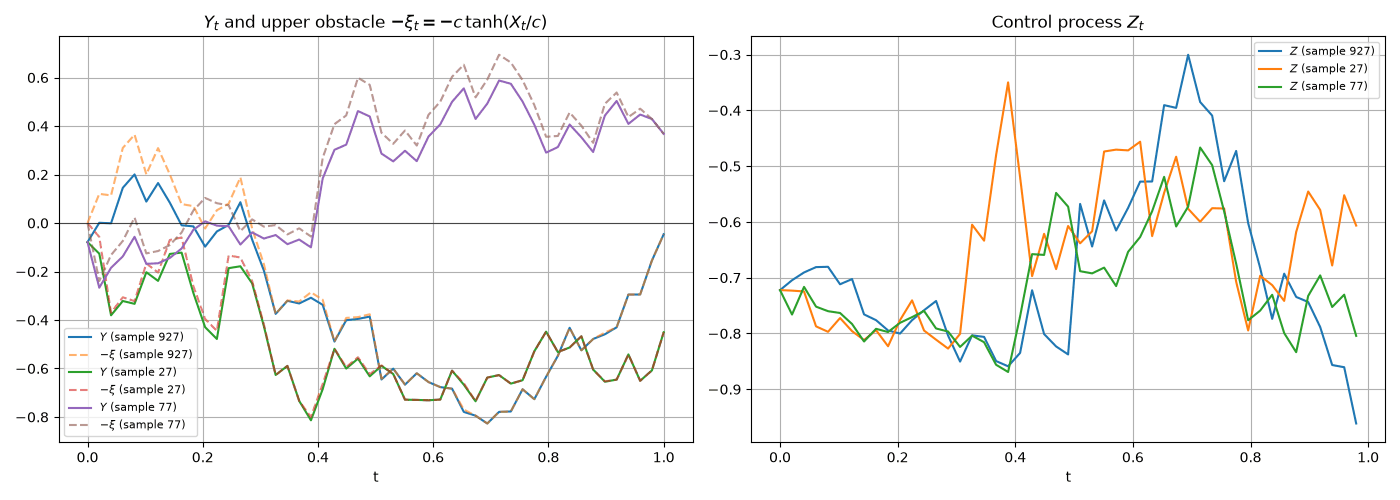
We study optimal stopping under dynamic risk measures with simultaneous ambiguity in the probability model and the discount rate. We introduce a paired ambiguity framework combining Girsanov model uncertainty with cash subadditive risk evaluation and characterize the stopping value by an upper reflected backward stochastic differential equation (BSDE). We establish structural properties of the resulting stopping operator and study quadratic drivers associated with entropic risk measures, obtaining explicit stopping rules in several benchmark cases. We then develop a deep learning scheme for the reflected quadratic BSDE. The convergence analysis uses discrete reflection and truncation to reduce the quadratic problem to a globally Lipschitz system and combines reflected BSDE discretization estimates with neural network approximation errors. Numerical experiments for American options illustrate the effects of discount rate and entropic ambiguity on stopping values and exercise decisions.
Citations and venue from Semantic Scholar (ODC-BY), refreshed weekly. Summary: Quant Letter (CC BY 4.0).