arXivLLMs & Text
Financial Language Models as Applied Artificial Intelligence Systems for News-Based Trading under Market Frictions
Introduces a market-friction-aware framework that converts timestamped financial news into auditable trading decisions while accounting for execution timing, transaction costs, and liquidity constraints.
Featured in No. 132 on 25 Sep 2026 · 3 days after release · 0 citations today
- Released
- 22 Sep 2026
- First featured
- No. 132 · 25 Sep 2026
- Citations (Semantic Scholar)
- 0
- Influential citations
- 0
- Published in
- Not yet, as far as Semantic Scholar knows
- Fanfare
- 3 of 5
- Identifier
- arXiv:2609.23703
- Authors
- Kemal Kirtac
Abstract
From arXiv (CC0).
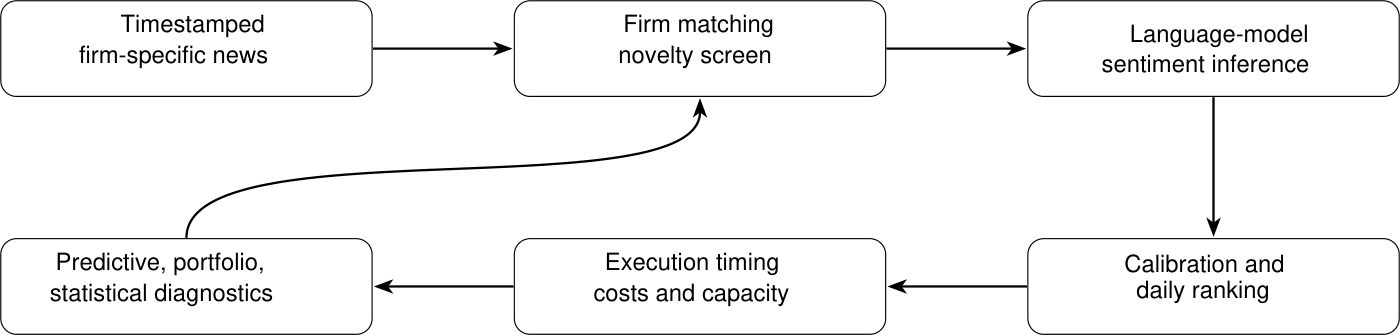
Financial language models can transform unstructured firm-specific news into structured decision signals, but financial AI research lacks an integrated deployment framework for evaluating whether those signals remain useful in financial decision systems. Computer science research has developed strong methods for time-series forecasting, text classification, multimodal stock prediction, graph-based market modeling, and machine-learning operations, yet these streams do not provide a domain-specific protocol that jointly tests financial language-model outputs under event-time observability, probability calibration, execution timing, transaction costs, liquidity constraints, capacity limits, operational diagnostics, and statistical inference. We introduce MFAST, a Market-Friction-Aware Sentiment-to-Trading framework that converts timestamped financial text into auditable, reproducible, and market-feasible trading decisions. The application is news-based trading, where firm-specific text must be linked to securities before portfolio decisions can be evaluated. The framework links Refinitiv News Analytics to Center for Research in Security Prices (CRSP) equity data, restricts the primary out-of-sample evaluation to post-release news outside disclosed foundation-model data-freshness periods, and adds a public replication arm using open financial text and public price data. Results show that decoder-only language models outperform encoder baselines and dictionary sentiment in classification, calibration, return prediction, and net portfolio performance, while operational diagnostics reveal trade-offs among accuracy, latency, memory, throughput, and inference cost. The paper shows that credible evaluation of financial language models requires an end-to-end engineering approach combining language understanding, temporal discipline, market-friction-aware deployment, and reproducible validation.
Citations and venue from Semantic Scholar (ODC-BY), refreshed weekly. Summary: Quant Letter (CC BY 4.0).