arXivEconometrics & Forecasting
Stealing profits: Spread-based temporal hierarchy forecasting for day-ahead electricity markets
Jointly reconciling hourly price and spread forecasts improves intraday electricity price prediction accuracy by up to 19.7% and battery-arbitrage profits by up to 10.4%.
Featured in No. 132 on 25 Sep 2026 · 3 days after release · 0 citations today
- Released
- 22 Sep 2026
- First featured
- No. 132 · 25 Sep 2026
- Citations (Semantic Scholar)
- 0
- Influential citations
- 0
- Published in
- Not yet, as far as Semantic Scholar knows
- Fanfare
- 3 of 5
- Identifier
- arXiv:2609.23223
- Authors
- Arkadiusz Lipiecki et al.
Abstract
From arXiv (CC0).
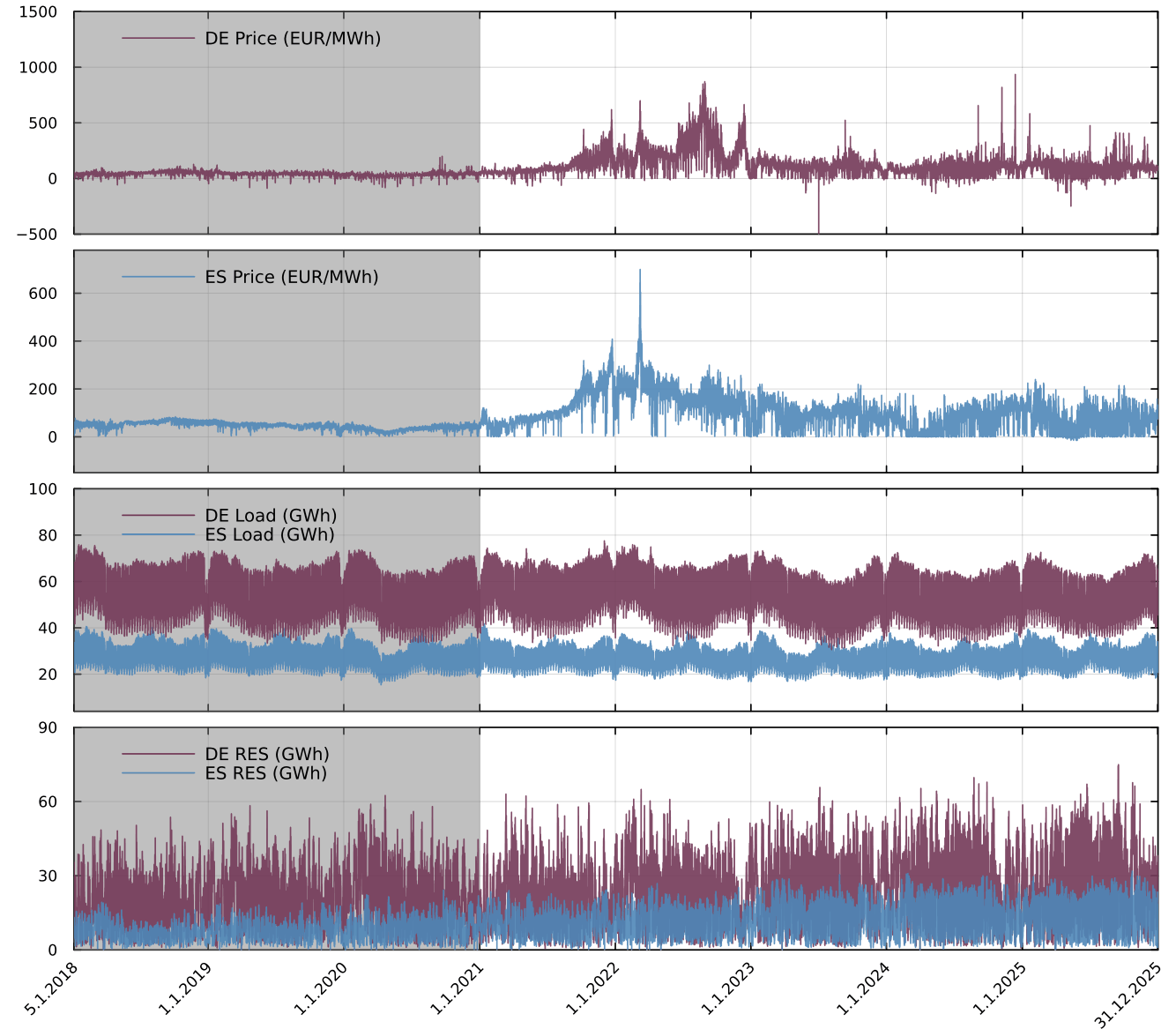
Day-ahead electricity price forecasts support trading and storage decisions, but for battery arbitrage predicting intraday price spreads is more relevant than predicting individual hourly prices. Here we show that a temporal hierarchy forecasting (THieF) framework that jointly reconciles forecasts of hourly electricity prices and all intraday price spreads consistently improves performance across two major European electricity markets and three different forecasting architectures. Using five years of out-of-sample data from Germany and Spain, we obtain accuracy improvements of up to 19.7% and profit gains of up to 10.4% relative to unreconciled hourly price forecasts. The gains persist even for a highly accurate pretrained TabPFN foundation model. Our results demonstrate that exploiting coherent relationships between economically relevant forecasting targets can improve both predictive accuracy and decision value, and that better statistical forecasts do not necessarily imply better economic decisions.
Citations and venue from Semantic Scholar (ODC-BY), refreshed weekly. Summary: Quant Letter (CC BY 4.0).