arXivEconometrics & Forecasting
The "Rough" HAR Model
Augmenting HAR with a negative moving-average component approximates rough dynamics, outperforming classical models out-of-sample and matching continuous-time rough model accuracy.
Featured in No. 132 on 25 Sep 2026 · 4 days after release · 0 citations today
- Released
- 21 Sep 2026
- First featured
- No. 132 · 25 Sep 2026
- Citations (Semantic Scholar)
- 0
- Influential citations
- 0
- Published in
- Not yet, as far as Semantic Scholar knows
- Fanfare
- 3 of 5
- Identifier
- arXiv:2609.21587
- Authors
- Mikkel Bennedsen et al.
Abstract
From arXiv (CC0).
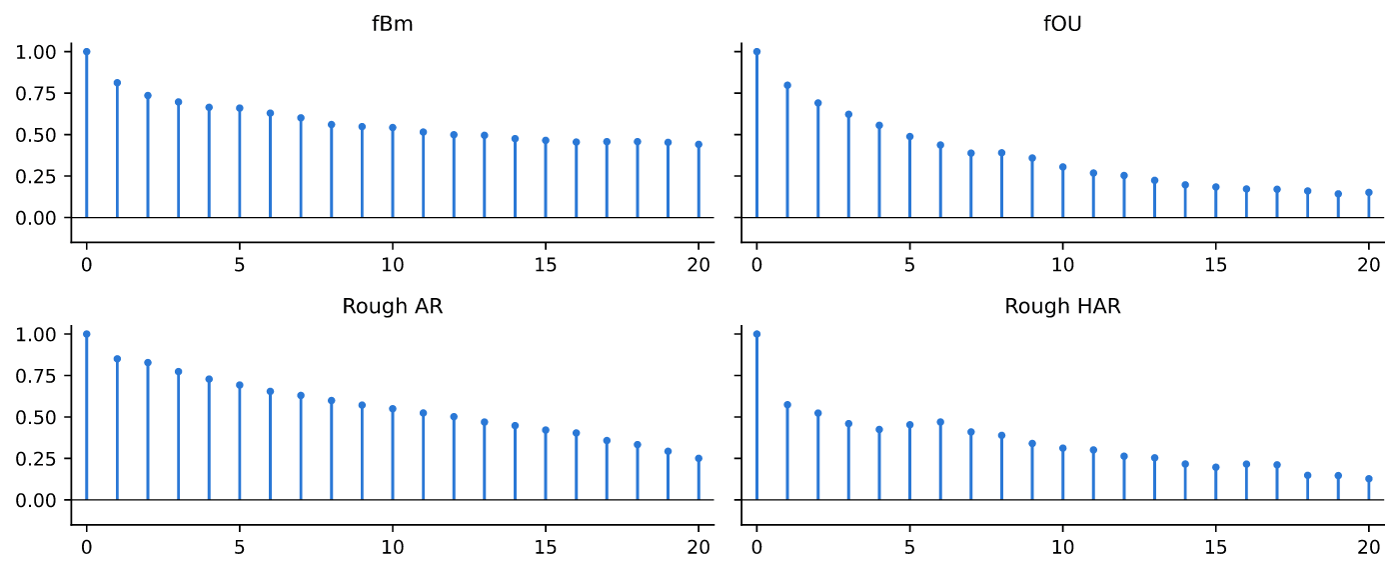
This paper proposes discrete-time approximations to rough continuous-time models of realized variance (RV). The leading rough models can be viewed as autoregressive processes driven by fractional Gaussian noise. We show that the Wold representation of this noise concentrates its dependence at the first lag when the Hurst parameter is below one half. Augmenting the autoregressive (AR) and heterogeneous autoregressive (HAR) models with a first-order moving-average (MA(1)) component therefore approximates the roughness, and the MA coefficient maps almost linearly into the Hurst parameter. We refer to these extensions as the "rough" AR and "rough" HAR models. Estimating them on the log RV of ten ETFs, we find negative MA coefficients for every asset, and the implied Hurst parameters align closely with the estimates from the continuous-time models. In the HAR literature, the negative MA(1) component is a significant feature that has been largely overlooked. In out-of-sample comparisons, the "rough" models outperform their classical counterparts for nearly every asset and horizon, with the largest gains at short horizons, and their accuracy is comparable to that of the rough continuous-time models but much easier to estimate by standard off-the-shelf software.
Citations and venue from Semantic Scholar (ODC-BY), refreshed weekly. Summary: Quant Letter (CC BY 4.0).